5 Conservation of Mass
The ultrasound section built an instrument that measures a blood jet’s velocity. To convert that velocity reading into a pressure that can be interpreted by a clinician, we must first understand the principle of conservation of mass.
Conservation of mass is a core concept that is reused throughout engineering and science. It is powerful and intuitive: mass cannot be created or destroyed; it can only move from one place to another or change form.
Mass balance - concept
A major tool in engineering is building equations that describe how quantities like mass, momentum, and energy change over time within a system. These equations allow engineers to predict the behavior of physical systems and design them effectively. These equations are often called balance equations because they keep track of the “balance” of a quantity within a control volume. We will use this approach to understand how mass is conserved in fluid flow, which is essential for converting velocity measurements into pressure estimates in the heart.
The rate of accumulation equals the rate in minus the rate out. Expressing the mass balance as a rate, rather than as a static total, makes it possible to track how the mass changes continuously over time.
\[\frac{d(\text{mass})}{dt} = \frac{d(\text{mass in})}{dt} - \frac{d(\text{mass out})}{dt}\]
This resembles ordinary bookkeeping: a bank balance grows if deposits exceed withdrawals. Determining the rate of accumulation requires knowing how much was added (dollars earned per month) and how much was taken out (dollars spent per month).
Before we can write “rate in” and “rate out,” we need to define what they are going into and coming out of. This region of space is called the control volume.
A mass balance keeps track of what goes into and comes out of the control volume. Control volumes are defined in different coordinate systems. For example, a cartesian control volume might be a useful choice if the flow is in a channel. In contrast, a cylindrical control volume is often convenient for flow in pipes.
Mass balance - derivation of the continuity equation
For an incompressible (no change in density) fluid in steady flow, the volume crossing any cross-section per unit time is fixed: whatever volume enters a segment each second must leave it each second, since the fluid neither accumulates nor compresses.
Blood, like water, is incompressible to an excellent approximation: its volume is essentially unchanged at the pressures the heart can generate. Where the channel narrows, the velocity must rise to carry the same volume through the smaller area. Putting a thumb over the end of a garden hose narrows the opening and produces a faster jet, the same effect at work here.
To make this quantitative, consider blood flowing through a vessel of cross-sectional area \(A\) at speed \(v\). The volumetric flow rate \(Q\) — the volume passing a fixed cross-section per time — is the product of area and speed:
\[Q = A\,v,\]
Common units of flow rate are cubic meters per second (m³/s).
In a time \(\Delta t\), the fluid advances a distance \(v\,\Delta t\) and sweeps out a volume \(A \times v\,\Delta t\); dividing by \(\Delta t\) gives a volume per second of \(A v\). Applying conservation of volume to a pipe that changes area shows that the flow rate is the same at any point along the pipe.
\[Q_1 = Q_2 \qquad\Longrightarrow\qquad A_1 v_1 = A_2 v_2 .\]
This is the equation of continuity (Ling et al. 2016) in its simplest form.
Take a rigid tube that tapers from area \(A_1\) to area \(A_2\), full of an incompressible fluid of density \(\rho\), and watch a short interval \(\Delta t\)
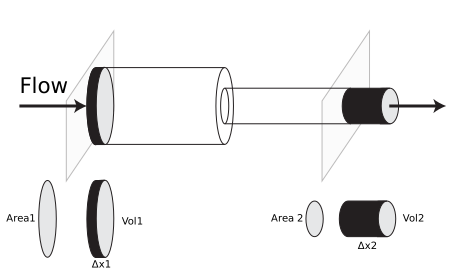
At the inlet the fluid moves at speed \(v_1\), so during \(\Delta t\) it advances a distance \(v_1\,\Delta t\) and a slug of volume
\[V_1 = A_1\,v_1\,\Delta t\]
crosses into the tube. At the outlet, over the same interval, a slug of volume \(V_2 = A_2\,v_2\,\Delta t\) crosses out. The mass entering is \(\rho V_1\) and the mass leaving is \(\rho V_2\). Nothing is created, destroyed, or stored inside the rigid tube, so the two masses are equal:
\[\rho\,A_1 v_1\,\Delta t = \rho\,A_2 v_2\,\Delta t .\]
Because the fluid is incompressible its density \(\rho\) is the same at both ends, and it cancels; so does the common \(\Delta t\). What survives is the equation of continuity,
\[A_1 v_1 = A_2 v_2 = Q ,\]
This statement that volumetric flow rate \(Q\) is constant assumed an incompressible fluid. Gases, which are compressible, need the fuller form with \(\rho\) kept inside.
Applying a mass balance to a small, fixed rectangular box, and then shrinking that box down, yields an equation that holds at every point in a fluid, at every instant, regardless of the flow’s geometry.
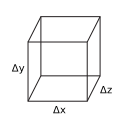
Take a control volume that is a small rectangular box of side lengths \(\Delta x\), \(\Delta y\), \(\Delta z\), fixed in space, with one corner at the point \((x, y, z)\) (Figure 5.2). Let \(\rho(x, y, z, t)\) be the fluid density and \(v_x, v_y, v_z\) the components of its velocity, all possibly varying from point to point and moment to moment.
Consider only the pair of faces perpendicular to \(x\), each of area \(\Delta y\, \Delta z\). Mass flows in through the face at \(x\) at rate \(\rho v_x \big|_x \, \Delta y\, \Delta z\), and out through the face at \(x + \Delta x\) at rate \(\rho v_x\big|_{x+\Delta x}\, \Delta y\, \Delta z\).
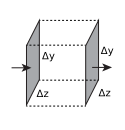
The net mass added to the box is
\[\Big(\rho v_x\big|_{x} - \rho v_x\big|_{x+\Delta x}\Big)\, \Delta y\, \Delta z = -\,\frac{\rho v_x\big|_{x+\Delta x} - \rho v_x\big|_{x}}{\Delta x}\; \Delta x\, \Delta y\, \Delta z .\]
As \(\Delta x \to 0\), the fraction becomes the partial derivative \(\partial(\rho v_x)/\partial x\), so this pair of faces contributes \(-\dfrac{\partial(\rho v_x)}{\partial x}\, \Delta x\,\Delta y\,\Delta z\) to the net inflow.
If this logic is repeated for all faces, the \(y\)- and \(z\)-face pairs contribute analogous terms, so the total mass flowing into the box is
\[-\left(\frac{\partial(\rho v_x)}{\partial x} + \frac{\partial(\rho v_y)}{\partial y} + \frac{\partial(\rho v_z)}{\partial z}\right) \Delta x\, \Delta y\, \Delta z = -\,\nabla\cdot(\rho \mathbf{v})\; \Delta \mathcal{V},\]
where \(\Delta\mathcal{V} = \Delta x\,\Delta y\,\Delta z\) is the (fixed) volume of the box and \(\nabla\cdot(\rho\mathbf{v})\) is the divergence of the mass flux.
The mass inside the box is \(\rho\,\Delta\mathcal{V}\), and since the box itself does not move or change size, its rate of accumulation is \(\dfrac{\partial \rho}{\partial t}\,\Delta\mathcal{V}\). The mass balance becomes:
\[\frac{\partial \rho}{\partial t}\, \Delta\mathcal{V} = -\,\nabla\cdot(\rho\mathbf{v})\, \Delta\mathcal{V} .\]
Dividing through by \(\Delta\mathcal{V}\) leaves the continuity equation,
\[\frac{\partial \rho}{\partial t} + \nabla\cdot(\rho \mathbf{v}) = 0 ,\]
The continuity equation simplifies a great deal for blood flow. In steady flow, conditions at each point do not change with time, so \(\partial \rho/\partial t = 0\). Blood is also, to an excellent approximation, incompressible: its density \(\rho\) does not vary from point to point, so it can be pulled out of the divergence, leaving \(\nabla\cdot\mathbf{v} = 0\) — the velocity field alone must have zero divergence.
Translating that speed into a pressure requires the second conservation law: conservation of energy, developed next.