Fick’s second law describes how a concentration profile changes with space (x) and time (t). When the concentration does not change with time, the system is said to be at steady state.
Steady state
A system is at steady state when the concentration at every point is constant in time, \(\partial c/\partial t = 0\). The species may still have flux.
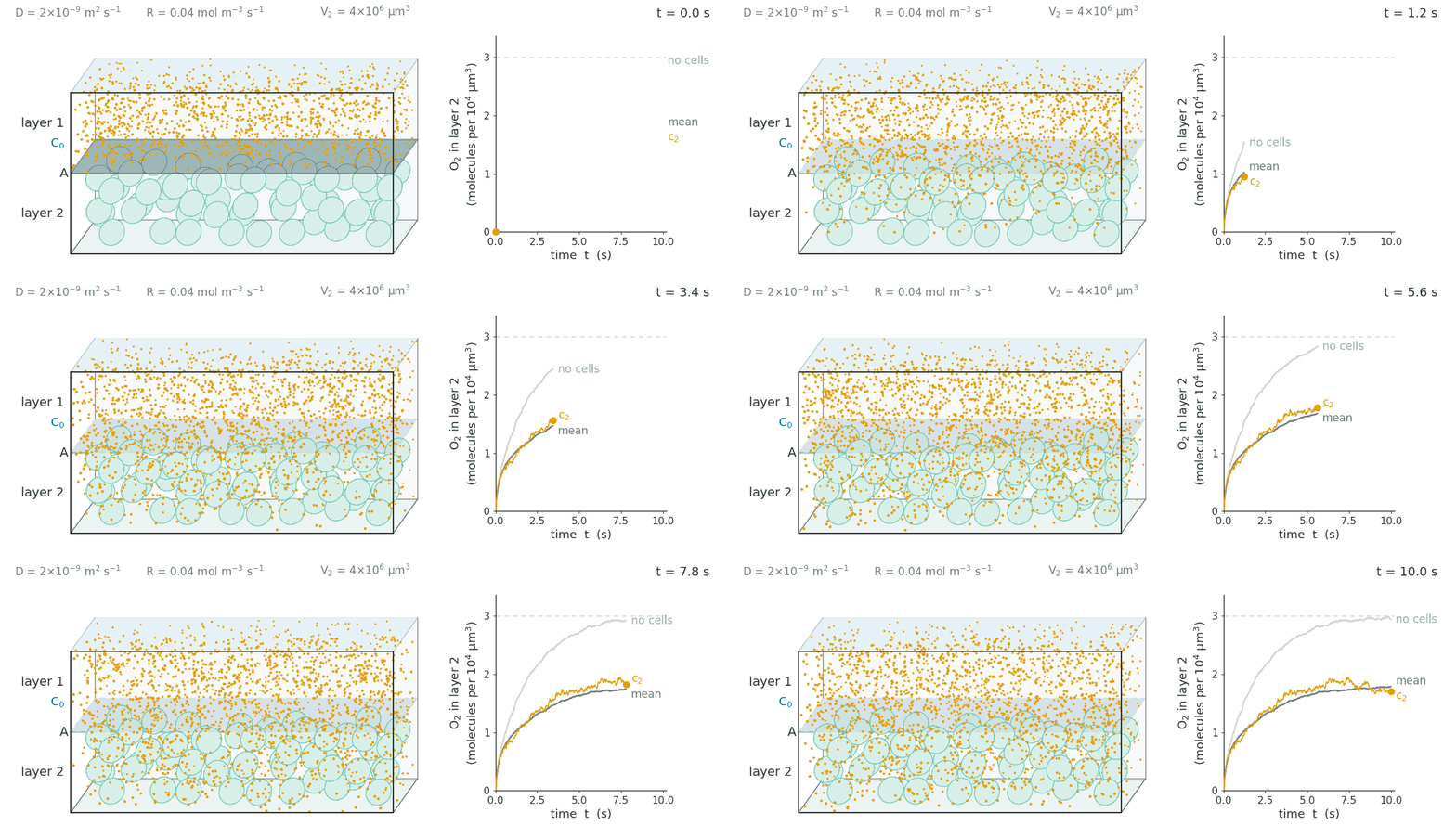
Let’s watch the concentration in the graft change over time (Figure 19.1).
Steady state does not mean the concentration is the same everywhere, nor does it mean that oxygen flux is zero. A graft at steady state has oxygen flowing in through its surface that is consumed by cells throughout. The inflow and the consumption balance at every point, so the concentration stops changing. Because \(c\) then depends on \(x\) alone, the partial derivatives become ordinary derivatives.
Setting \(\partial c/\partial t = 0\) in the reaction–diffusion equation gives the steady-state balance:
\[D\,\frac{\mathrm{d}^2 c}{\mathrm{d}x^2} = R .\]
Zero-order consumption
The reaction term \(R\) is the rate at which cells consume the species, in this case oxygen. The units are moles per volume per time.
The reaction rate can vary with concentration, and the way it depends on concentration is called the order of the reaction.
A zero-order reaction is one where the rate does not depend on the concentration at all, while a first-order reaction is one where the rate is directly proportional to the concentration. This is represented as:
A consumption rate \(R\) is zero-order when it does not depend on the concentration. It is first-order when it is proportional to the concentration, \(R \propto c\).
\[R = \begin{cases}
k_0 & \text{zero-order} \\
k_1 c & \text{first-order}
\end{cases}\]
The DermaGraft model treats oxygen consumption as zero-order. Each cell consumes oxygen at a fixed rate \(k_{\text{cell}}\), taken here as the value measured for human dermal fibroblasts in 3D culture (Streeter and Cheema 2011), so the volumetric rate is \(R = k_{\text{cell}}\,\rho_{\text{cell}}\), set by how many cells are present and not by how much oxygen surrounds them. This is a modeling assumption, and it can hold only while oxygen is plentiful: a cell cannot consume oxygen that is not there, so the true rate must fall as \(c\) approaches zero. This is convenient because the equation becomes solvable. With \(R\) constant, \(D\,\mathrm{d}^2c/\mathrm{d}x^2 = R\) has a constant right-hand side and integrates directly, twice. A rate that depended on \(c\) would make the equation harder to solve.
Boundary conditions
The steady-state equation is second order in \(x\), so its solution has two integration constants. Three kinds of boundary condition cover the cases in this module.
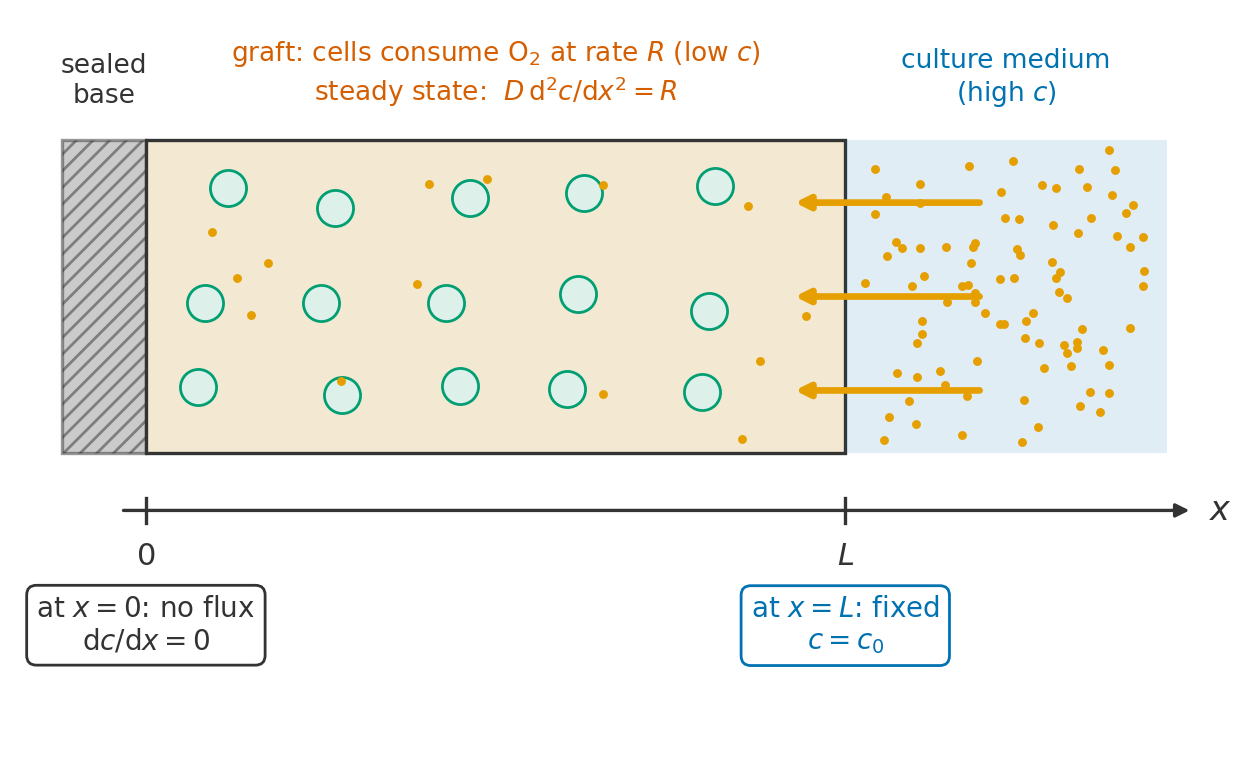
- Fixed concentration. The concentration at the boundary is set: \(c = c_b\). This describes a face in contact with a large, well-mixed reservoir, such as the culture medium, whose concentration the slab does not change.
- No flux. Nothing crosses the boundary: \(J = 0\). Fick’s first law turns this into a condition on the slope, \(\mathrm{d}c/\mathrm{d}x = 0\). It describes an impermeable wall, such as the sealed base of a graft.
- Fixed flux. The flux across the boundary is set: \(-D\,\mathrm{d}c/\mathrm{d}x = J_0\). It describes a boundary that supplies or removes the species at a known rate. No flux is the special case \(J_0 = 0\).
Figure 19.2 shows the graft used in this module. The face in contact with the culture medium has a fixed concentration, and the sealed base has no flux.
Steady diffusion through a slab
The simplest use of boundary conditions has no reaction. Consider a slab of thickness \(L\) with the concentration held at \(c_0\) on the face at \(x = 0\) and at \(c_L\) on the face at \(x = L\), with \(R = 0\).
Integrate twice. With \(R = 0\) the steady-state equation is \(\mathrm{d}^2c/\mathrm{d}x^2 = 0\). Integrating once gives a constant slope, and integrating again gives a straight line,
\[c(x) = A\,x + B .\]
Apply the boundary conditions. \(c(0) = c_0\) gives \(B = c_0\), and \(c(L) = c_L\) gives \(A = (c_L - c_0)/L\), so
\[c(x) = c_0 + \frac{c_L - c_0}{L}\,x .\]
Find the flux. The slope is the constant \((c_L - c_0)/L\), so Fick’s first law gives
\[J = -D\,\frac{c_L - c_0}{L} = \frac{D\,(c_0 - c_L)}{L} .\]
The flux is independent of \(x\), as the steady-state balance requires when \(R = 0\). It is proportional to the concentration difference across the slab and inversely proportional to its thickness: doubling the thickness halves the flux.
For a hydrogel slab \(0.5\ \text{mm}\) thick with \(D = 1\times10^{-9}\ \text{m}^2/\text{s}\), held at \(c_0 = 2\ \text{mol/m}^3\) on one face and \(c_L = 0\) on the other, the flux is \(J = (10^{-9})(2)/(5\times10^{-4}) = 4\times10^{-6}\ \mathrm{mol\,m^{-2}\,s^{-1}}\).
Exercises
A graft of thickness \(L\) sits at steady state on a sealed base, with \(x = 0\) at the base and \(x = L\) at the surface. Oxygen is consumed at a constant rate \(R > 0\) throughout.
What is \(\partial c/\partial t\) at every point? Is the flux zero?
At steady state the species balance, \(0 = -\mathrm{d}J/\mathrm{d}x - R\), gives \(\mathrm{d}J/\mathrm{d}x = -R\). Integrate it with the no-flux condition at the base to find \(J(x)\).
For \(L = 0.4\ \text{mm}\) and \(R = 1.19\times10^{-3}\ \mathrm{mol\,m^{-3}\,s^{-1}}\), compute the magnitude of the flux at the surface and say what it represents.
At steady state \(\partial c/\partial t = 0\) at every point. The flux is not zero: oxygen enters through the surface and is consumed by the cells, so it is flowing through the graft.
Integrating gives \(J(x) = -R\,x + J(0)\). The sealed base has no flux, \(J(0) = 0\), so
\[J(x) = -R\,x .\]
The flux is zero at the base and its magnitude grows linearly toward the surface. The negative sign means it points toward decreasing \(x\), from the surface down into the graft.
- At \(x = L\) the magnitude is \(RL = (1.19\times10^{-3})(0.4\times10^{-3}) \approx 4.8\times10^{-7}\ \mathrm{mol\,m^{-2}\,s^{-1}}\). This is the oxygen that must enter each square meter of the surface every second to supply all the cells beneath it.
Cells in a graft consume oxygen at the zero-order rate \(R_0 = 1.19\times10^{-3}\ \mathrm{mol\,m^{-3}\,s^{-1}}\). A first-order alternative, \(R = kc\), is chosen to give the same rate at the surface concentration \(c_0 = 0.2\ \text{mol/m}^3\).
Find \(k\) and its units.
Compute the consumption rate each law predicts at \(c = 0.05\ \text{mol/m}^3\).
\(R_0 = kc_0\) gives \(k = R_0/c_0 = (1.19\times10^{-3})/0.2 \approx 6\times10^{-3}\ \text{s}^{-1}\). The units are \((\mathrm{mol\,m^{-3}\,s^{-1}})/(\mathrm{mol\,m^{-3}}) = \text{s}^{-1}\).
The zero-order law still gives \(1.19\times10^{-3}\ \mathrm{mol\,m^{-3}\,s^{-1}}\). The first-order law gives \(kc \approx (6\times10^{-3})(0.05) = 3\times10^{-4}\ \mathrm{mol\,m^{-3}\,s^{-1}}\), a quarter of the surface value, because the concentration is a quarter of the surface value.
State the boundary conditions, as equations, for each case.
A slab of thickness \(L\) separates two well-stirred solutions, of concentration \(c_1\) at \(x = 0\) and \(c_2\) at \(x = L\).
A graft of thickness \(2L\) is cultured floating in medium at concentration \(c_0\), so both faces are exposed. Take \(x = 0\) at the middle of the graft, with the faces at \(x = -L\) and \(x = +L\). By symmetry, the profile is the same on either side of the middle.
Compare case (b) with the graft on a sealed base in Figure 19.2. What do they have in common?
Both faces are in contact with a reservoir, so both conditions fix the concentration: \(c(0) = c_1\) and \(c(L) = c_2\).
Each face is in contact with the medium, so \(c(-L) = c(+L) = c_0\). Because the profile is the same on both sides of the middle, it cannot slope one way or the other there, so \(\mathrm{d}c/\mathrm{d}x = 0\) at \(x = 0\).
In (b), the right half of the graft, \(0 \le x \le L\), has a fixed concentration \(c_0\) at \(x = L\) and no flux at \(x = 0\). These are the same two conditions as a graft of thickness \(L\) on a sealed base. A graft of thickness \(2L\) fed from both faces therefore has the same profile in each half as a graft of thickness \(L\) fed from one face and sealed at the other.
A membrane \(0.2\ \text{mm}\) thick, with \(D = 5\times10^{-10}\ \text{m}^2/\text{s}\), separates a solution at \(c_0 = 10\ \text{mol/m}^3\) on the left from one at \(c_L = 2\ \text{mol/m}^3\) on the right. There is no reaction, and the system is at steady state.
Find the steady flux \(J\).
What is the concentration at the midpoint of the membrane?
How many moles cross a \(25\ \text{cm}^2\) patch of the membrane in \(10\ \text{min}\)?
\(J = D(c_0 - c_L)/L = (5\times10^{-10})(10 - 2)/(2\times10^{-4}) = 2\times10^{-5}\ \mathrm{mol\,m^{-2}\,s^{-1}}\), directed from the left to the right.
The profile is a straight line between the two face values, so the midpoint holds their average, \((10 + 2)/2 = 6\ \text{mol/m}^3\).
With \(A = 25\ \text{cm}^2 = 2.5\times10^{-3}\ \text{m}^2\) and \(t = 600\ \text{s}\), \(n = JAt = (2\times10^{-5})(2.5\times10^{-3})(600) = 3.0\times10^{-5}\ \text{mol}\).
References
Streeter, Ian, and Umber Cheema. 2011.
“Oxygen Consumption Rate of Cells in 3D Culture: The Use of Experiment and Simulation to Measure Kinetic Parameters and Optimise Culture Conditions.” Analyst 136 (19): 4013–19.
https://doi.org/10.1039/c1an15249a.