Component Guide

The components

This book is organized with the following “blocks” that are consistent in style throughout.

Core concept

A core concept is just what it sounds like - an idea or principle that forms the foundation of a lesson or problem. It might have a written description and a mathematical form.

NoteCore concept — PCR amplification

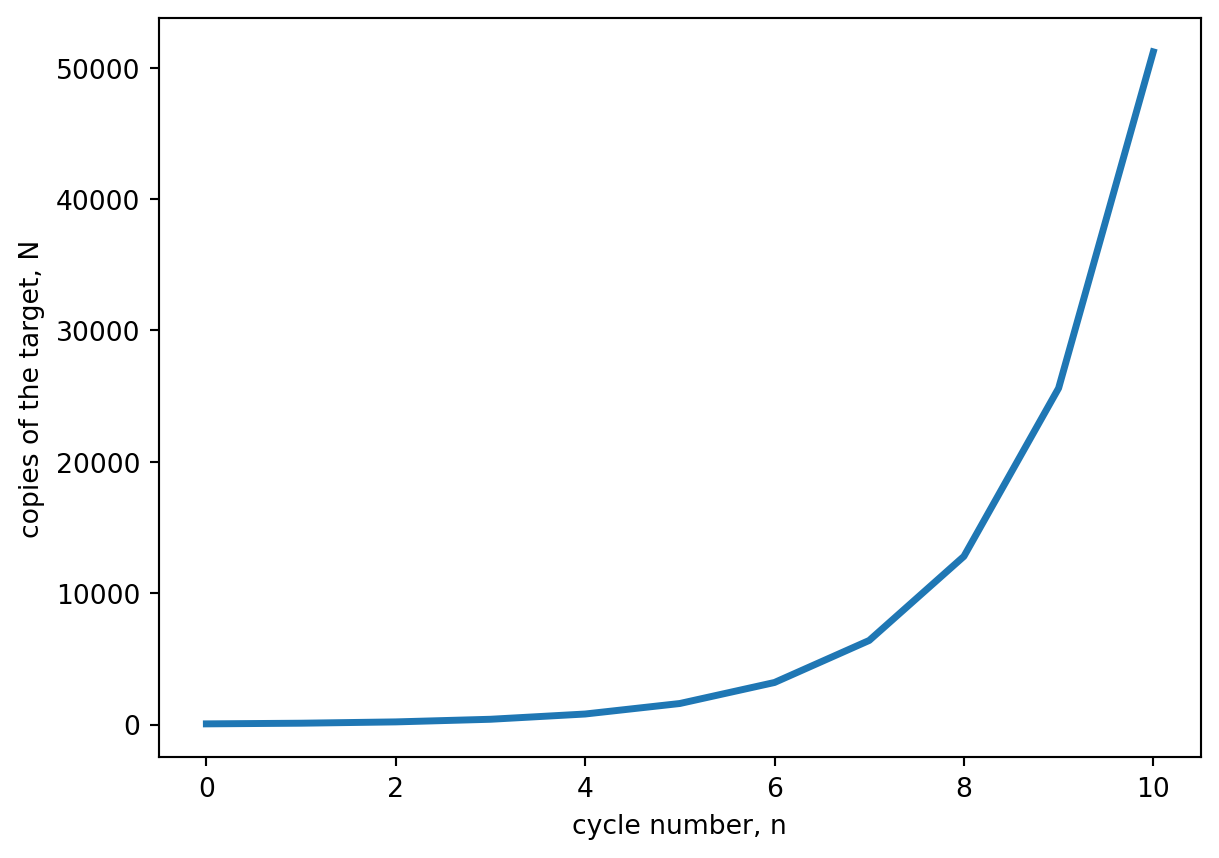
In ideal PCR, the number of DNA copies doubles each cycle.

We can write the amplification as:

\[N = N_0 2^n\]

where \(N_0\) is the initial number of DNA copies and \(n\) is the number of PCR cycles.

Derivation

It is important to understand the origin of an equation so that you can use it correctly. In a Derivation block, we present more full, rigorous math, collapsed so you can expand it or skip it. You’ll never be asked to derive an equation, so these blocks are to help deepen your understanding of the material and preview what you’ll see in your advanced courses.

After \(N\) steps of size \(\pm\Delta x\) with equal probability, the net displacement is the sum of the individual steps,

\[x_N = \sum_{i=1}^N \Delta X_i, \qquad \Delta X_i = \pm\Delta x \text{ with equal probability, independent}.\]

Squaring and taking the expectation,

\[\langle x_N^2 \rangle = \left\langle \left(\sum_{i=1}^N \Delta X_i\right)^2 \right\rangle = \sum_{i=1}^N \langle \Delta X_i^2 \rangle + \sum_{i \neq j} \langle \Delta X_i \Delta X_j \rangle.\]

Each step satisfies \(\Delta X_i^2 = \Delta x^2\) regardless of sign, so the first sum is \(N\,\Delta x^2\). The steps are independent with \(\langle \Delta X_i \rangle = 0\), so \(\langle \Delta X_i \Delta X_j \rangle = \langle \Delta X_i \rangle \langle \Delta X_j \rangle = 0\) for every \(i \neq j\), and the second sum vanishes. This leaves

\[\langle x^2 \rangle = N\,\Delta x^2 .\]

Writing the step count as \(N = t/\Delta t\) and defining the diffusion coefficient \(D \equiv \Delta x^2 / (2\Delta t)\) so that \(\Delta x^2 = 2D\Delta t\),

\[\langle x^2 \rangle = \frac{t}{\Delta t}\cdot 2D\Delta t = 2Dt.\]
Knowledge check

A quick self-test mid-section, with the answer hidden until clicked. Try to attempt these without looking.

ImportantKnowledge check

A particle has diffusion coefficient \(D = 2\times10^{-9}\ \text{m}^2/\text{s}\). Roughly how far does it diffuse in one second?

Answer

\(\sqrt{\langle x^2 \rangle} = \sqrt{2Dt} \approx \sqrt{4\times10^{-9}} \approx 63\ \mu\text{m}\).

Code blocks

Writing code to plot or calculate is a core capability of an engineer. Think of python, or another programming language, as the best calculator you’ll ever need. Code blocks are hidden - click to expand. You can also copy the entire block and run it yourself. However, you’ll need to have the correct Python packages.

import numpy as np

D = 2e-9  # m^2/s, oxygen in water
L = 100e-6  # m, scaffold thickness
t = L**2 / (2 * D)
print(f"diffusion time ≈ {t:.2f} s")
diffusion time ≈ 2.50 s
Show the code
# Ideal PCR amplification grows exponentially with cycle number
import numpy as np
import matplotlib.pyplot as plt

N0 = 50
n = np.arange(0, 11)

N = N0 * 2 ** n
plt.plot(n, N, lw=2.6)
plt.xlabel("cycle number, n")
plt.ylabel("copies of the target, N")
plt.show()

Optional content

Optional content blocks contain things we think are interesting, but you are not expected to learn.

In three dimensions each axis diffuses independently, giving \(\langle r^2 \rangle = 6Dt\). The dimensionality sets the coefficient: 2, 4, or 6 in 1D, 2D, 3D.

Exercises at the end of a section

We end sections with Problems. Each Problem is visible; each Answer is nested inside it and hidden until clicked. Again, try to solve the problems without looking at the answers. When you do, give yourself a pat on the back. You’re building neural circuits in your brain that promote problem solving (and self-control)! It would have been so easy to peek, but you didn’t.

Note▶ Answers are hidden by default

The gray Answer blocks below start collapsed. Click an Answer header to reveal the worked solution; click it again to hide it. (The same collapse behavior is used for the Knowledge check answer higher up the page — try it.)

TipProblem 1

Oxygen has \(D \approx 2\times10^{-9}\ \text{m}^2/\text{s}\) in water. Estimate the time for oxygen to diffuse across a \(100\ \mu\text{m}\)-thick tissue scaffold.

\[t = \frac{L^2}{2D} = \frac{(10^{-4})^2}{2\,(2\times10^{-9})} \approx 2.5\ \text{s}.\]

Diffusion over cellular distances is fast; over millimeters it becomes slow. This is why scaffolds must be kept thin.

Further reading

If you are excited about a topic, or want to dig deeper, you are encouraged to consult references in this block.

Further reading

  • Berg, Random Walks in Biology, Ch. 1.
  • Einstein (1905), on Brownian motion.