6 Conservation of Energy
We will use conservation of energy to understand how the velocity measured by the ultrasound is converted into a pressure drop that can be used to predict heart disease.
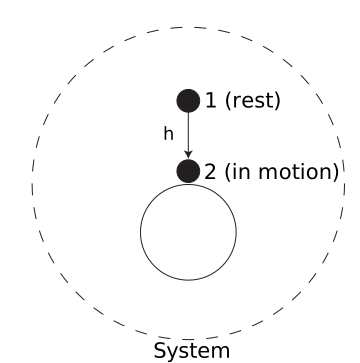
A ball of mass \(m\) is held at height \(h\) above the ground, then released. The system (ball + Earth) has no work or heat crossing its boundary, so
\[\Delta E = 0.\]
At the top the ball is at rest: energy is entirely potential, \(E = mgh\). Just before impact the ball has fallen to \(h = 0\): energy is entirely kinetic, \(E = \tfrac{1}{2}mv^2\). Setting them equal,
\[mgh = \tfrac{1}{2}mv^2.\]
Solving for \(v\) gives the impact speed, regardless of the ball’s mass:
\[v = \sqrt{2gh}.\]
This simple example captures the pattern that reappears throughout fluid dynamics: energy changes form but the total is conserved. In a flowing fluid the same principle relates speed, pressure, and height along a streamline.
Bernoulli equation
Conservation of energy, applied to a flowing fluid with several simplifications, yields the Bernoulli equation. This equation tells us that a constriction in a pipe causes fluid to speed up and drop in pressure. Conversely, when the pipe widens, the fluid slows down and its pressure increases.
A verbal description of the fluid comes first. Consider a small parcel of blood moving along its path through the vessel; that path is called a streamline. The parcel carries energy in three forms, most conveniently expressed per unit volume. The first is pressure energy: a parcel at pressure \(P\) can do work on the fluid ahead of it, and this energy per unit volume equals \(P\). The second is kinetic energy of motion, \(\tfrac{1}{2}\rho v^2\) per unit volume, where \(\rho\) is the blood’s density and \(v\) its speed. The third is gravitational potential energy, \(\rho g h\) per unit volume, where \(g\) is the acceleration of gravity and \(h\) the parcel’s height. Together these constitute the parcel’s entire energy budget. In the absence of friction (no viscosity to dissipate energy as heat) the total of the three terms is constant as the parcel moves along its streamline. Bernoulli’s equation is precisely this statement — conservation of energy for a flowing fluid — written per unit volume:
\[P + \tfrac{1}{2}\rho v^2 + \rho g h = \text{constant along a streamline}.\]
Because the three terms sum to a fixed total, an increase in one requires a decrease in another. When the parcel passes through a narrowing, it speeds up and its kinetic term \(\tfrac{1}{2}\rho v^2\) rises; in cases where the pipe does not change in height, the pressure term \(P\) must fall to keep the sum constant. The fluid trades speed for pressure.
Several methods derive Bernoulli’s equation; a fluid dynamics textbook develops others. The derivation that follows uses one such method.
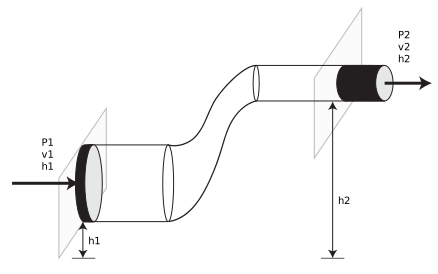
Take the steady, incompressible, frictionless flow between point 1 (pressure \(P_1\), speed \(v_1\), height \(h_1\)) and point 2 (pressure \(P_2\), speed \(v_2\), height \(h_2\)), and consider pushing a small volume \(\Delta V\) of fluid through this segment while tracking the resulting change in energy.
Work done by pressure. The fluid behind our slug pushes it forward, and the fluid ahead pushes back. At point 1 the pressure \(P_1\) acts over the area and the slug advances, doing work \(P_1\,\Delta V\) on it; at point 2 the slug does work \(P_2\,\Delta V\) against the fluid ahead. The net work done on the slug by pressure is therefore
\[W = P_1\,\Delta V - P_2\,\Delta V = (P_1 - P_2)\,\Delta V .\]
Change in kinetic energy. The slug has mass \(\rho\,\Delta V\), so speeding it from \(v_1\) to \(v_2\) changes its kinetic energy by
\[\Delta \text{KE} = \tfrac{1}{2}\rho\,\Delta V\,\big(v_2^2 - v_1^2\big).\]
Change in potential energy. Raising the same mass from \(h_1\) to \(h_2\) changes its gravitational potential energy by
\[\Delta \text{PE} = \rho\,\Delta V\,g\,\big(h_2 - h_1\big).\]
With no friction to spend energy as heat, the work done on the slug goes entirely into its kinetic and potential energy, \(W = \Delta \text{KE} + \Delta \text{PE}\):
\[(P_1 - P_2)\,\Delta V = \tfrac{1}{2}\rho\,\Delta V\,\big(v_2^2 - v_1^2\big) + \rho\,\Delta V\,g\,\big(h_2 - h_1\big).\]
Every term carries the same factor \(\Delta V\); divide it out and gather point 1 on the left, point 2 on the right:
\[P_1 + \tfrac{1}{2}\rho v_1^2 + \rho g h_1 = P_2 + \tfrac{1}{2}\rho v_2^2 + \rho g h_2 .\]
Since points 1 and 2 were any two points on the streamline, the combination \(P + \tfrac{1}{2}\rho v^2 + \rho g h\) must be the same everywhere along it — Bernoulli’s equation (Ling et al. 2016).
Bernoulli’s equation assumes a frictionless fluid, whereas real blood has viscosity — internal friction that dissipates energy as the fluid shears past the vessel walls. For the short, rapid passage through a valve orifice this loss is small and Bernoulli’s equation is an excellent approximation, which is why it applies well to the present problem. In a long, narrow vessel, by contrast, viscosity dominates and Bernoulli’s equation fails; that regime needs the Hagen–Poiseuille model of viscous flow, which is treated in a later section.