15 Mass Transport
Chemical species are the solutes that undergo mass transport within the solvent. A chemical species can be an atom, ion, or molecule that moves due to various driving forces. Solute and species are often used interchangeably in this context.
Almost everything in this section concerns a dilute solute carried through a liquid solvent, so “species” and “solute” refer to the same thing in most of what follows. The distinction matters only when the solvent itself is the thing being transported, as in osmosis.
What moves. A chemical species (solute) present in a solution (solvent). For example, oxygen in interstitial fluid, urea in blood.
Why it moves. A chemical species moves because of a driving force. Examples include:
- The bulk movement of fluid that the solute is in (advection)
- The random motion of the solute (diffusion)
- A charged molecule (ion) in an electric field (electromigration)
Species balance
To keep track of the moles of a species within a system, we use a mole balance, this time on the species rather than the total mass. We saw this concept earlier, but now we are extending it to a given species.
The rate of accumulation equals the rate in minus the rate out. But now, we have a reaction term. Species can be produced or consumed within the control volume due to chemical reactions. Expressing the mole balance as a rate, rather than as a static total, makes it possible to track how the moles change continuously over time.
\[\Delta(\text{moles of } i) = (\text{rate } i \text{ enters})\,\Delta t - (\text{rate } i \text{ leaves})\,\Delta t - (\text{rate } i \text{ is consumed})\,\Delta t\]
Each rate, multiplied by the length of the interval, gives the moles that term contributes over that interval. Dividing through by \(\Delta t\) then puts the balance back on a per-unit-time footing:
\[\frac{\Delta(\text{moles of } i)}{\Delta t} = (\text{rate } i \text{ enters}) - (\text{rate } i \text{ leaves}) - (\text{rate } i \text{ is consumed})\]
where \(i\) is the species being tracked. The reaction term is what separates a species balance from a total-mass balance. An individual species can be created or destroyed by reaction. A species that is produced rather than consumed simply carries a negative \(R\).
The control volume
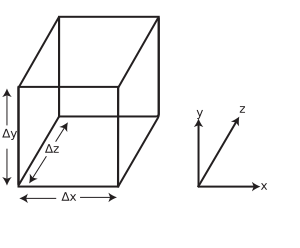
Let’s define a control volume that we will use to keep track of our species \(i\) (Figure 15.1):
Flux is an amount per area per time
To perform our mole balance on the control volume, we need to introduce the concept of flux. Flux of species \(i\) is the moles of \(i\) that enter or leave a unit area of the control volume per unit time, with SI units \(\mathrm{mol\,m^{-2}\,s^{-1}}\).
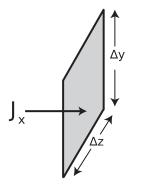
How much of species \(i\) enters through one of the faces (Figure 15.2)? Because flux is moles per unit area per unit time, the moles of species \(i\) entering through this face each second is \(J_x\,\Delta y\,\Delta z\): the flux multiplied by the area it crosses.
Apply the same logic to all the faces
Now let’s keep track of the flux \(J\) at all the faces. Species \(i\) enters through the face at \(x\) and leaves through the face at \(x + \Delta x\); the same holds for the two \(y\) faces and the two \(z\) faces. Each face contributes the flux crossing it multiplied by that face’s area, so
\[(\text{rate } i \text{ enters}) - (\text{rate } i \text{ leaves}) = \left(J_x\big|_x - J_x\big|_{x+\Delta x}\right)\Delta y\,\Delta z + \left(J_y\big|_y - J_y\big|_{y+\Delta y}\right)\Delta x\,\Delta z + \left(J_z\big|_z - J_z\big|_{z+\Delta z}\right)\Delta x\,\Delta y .\]
Each bracket is an in-minus-out difference for one pair of opposite faces, multiplied by the area of that pair. Everything here is still finite: two faces a distance \(\Delta x\) apart, with the flux evaluated at each one.
Assemble the balance
Write \(c_i\) for the concentration of species \(i\), the moles of \(i\) per unit volume. The box holds \(c_i\,\Delta x\,\Delta y\,\Delta z\) of it (concentration \(\times\) volume), and because the box is fixed in space its volume does not change. Over an interval \(\Delta t\) the moles inside therefore change at the rate
\[\frac{\Delta(\text{moles of } i)}{\Delta t} = \frac{\Delta c_i}{\Delta t}\,\Delta x\,\Delta y\,\Delta z .\]
Each face term is already a rate, and if species \(i\) is also consumed inside the box at a volumetric rate \(R\) it removes \(R\,\Delta x\,\Delta y\,\Delta z\). The mole balance for the box is then
\[\frac{\Delta c_i}{\Delta t}\,\Delta x\,\Delta y\,\Delta z = \left(J_x\big|_x - J_x\big|_{x+\Delta x}\right)\Delta y\,\Delta z + \left(J_y\big|_y - J_y\big|_{y+\Delta y}\right)\Delta x\,\Delta z + \left(J_z\big|_z - J_z\big|_{z+\Delta z}\right)\Delta x\,\Delta y - R\,\Delta x\,\Delta y\,\Delta z .\]
Divide through by the volume \(\Delta x\,\Delta y\,\Delta z\). Each face term loses one area, leaving a flux difference over the distance between the two faces:
\[\frac{\Delta c_i}{\Delta t} = -\,\frac{J_x\big|_{x+\Delta x} - J_x\big|_x}{\Delta x} - \frac{J_y\big|_{y+\Delta y} - J_y\big|_y}{\Delta y} - \frac{J_z\big|_{z+\Delta z} - J_z\big|_z}{\Delta z} - R \]
Every term is still a difference divided by a finite step. Nothing has been differentiated, in space or in time.
Shrink the box
Now shrink the box to a point and the time interval to an instant: \(\Delta x\), \(\Delta y\), \(\Delta z\) and \(\Delta t\) all go to zero. Each quotient is a change divided by the step across which it changes, which is the definition of a derivative, so each becomes one:
\[\frac{\partial c_i}{\partial t} = -\left(\frac{\partial J_x}{\partial x} + \frac{\partial J_y}{\partial y} + \frac{\partial J_z}{\partial z}\right) - R \]
This equation says that concentration rises when flux converges, falls when flux diverges, and is adjusted by whatever reaction adds or removes. If we only keep track of one direction (x), this equation can be written as: \[\frac{\partial c_i}{\partial t} = -\frac{\partial J}{\partial x} - R \]
Notice what this does not say. It relates the concentration to the flux, but it never says what the flux is. Conservation of a species is bookkeeping. We still need expressions for \(J\)!
This will depend on what is causing flux. A drop of dye placed in a still glass of water spreads slowly outward, coloring the whole glass only after many hours; this is diffusion. When the water itself flows and carries the solute along with it, the transport is called advection (or convection); other driving forces (electric fields, pressure gradients, gravity) may also be present (Fournier 2017). A complete species balance sums every flux that crosses the control volume.