33 The One-Compartment Model
A 61 kg patient needs pain relief for 8 hours from a single injection of morphine into a vein. The morphine comes as a stock solution of known concentration. How much does the doctor load into the syringe?
The problem gives these values:
- the patient’s mass is 61 kg and the volume of distribution is \(V_d = 1\) L/kg;
- the elimination rate constant is \(k_e = 0.35\) h\(^{-1}\);
- relief requires a plasma concentration of at least the minimum effective concentration, \(C_{\min} = 8.2\times10^{-3}\) mg/L, for 8 h;
- the stock is 10 mg/mL.
The body is modeled as one well-mixed compartment. A mass balance for the drug gives \(dC/dt = -k_eC\), the same form as heat loss, capacitor discharge, and population decay. Its solution is an exponential decay. Setting the concentration at 8 h equal to \(C_{\min}\) gives the starting concentration, then the dose, then the syringe volume.
The same rate constant gives the elimination half-life and, with the volume of distribution, the clearance.
The single-compartment model
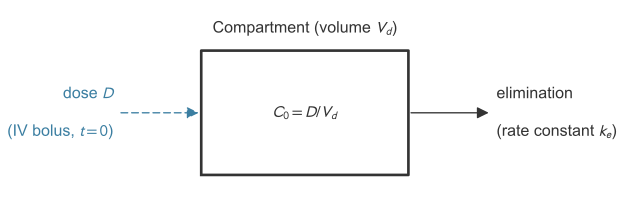
The simplest compartment model treats the whole body as one compartment with a single uniform concentration \(C(t)\). Its volume of distribution \(V_d\) is the volume that would hold the drug at the concentration measured in the plasma (defined in Section 33.3). The amount of drug in the compartment and its concentration are related by
\[A(t) = V_d\,C(t),\]
so tracking the amount and tracking the concentration are equivalent once \(V_d\) is known (Figure 33.1).
The model assumes:
- The entire body is a single, well-mixed compartment: the drug has the same concentration \(C\) everywhere in it.
- The drug enters and distributes instantaneously.
- The drug is eliminated (removed from the body) at a rate set by a fixed elimination rate constant \(k_e\). The rate law of Section 33.2 gives the removal rate in terms of \(k_e\) and the concentration.
- The volume \(V_d\) does not change.
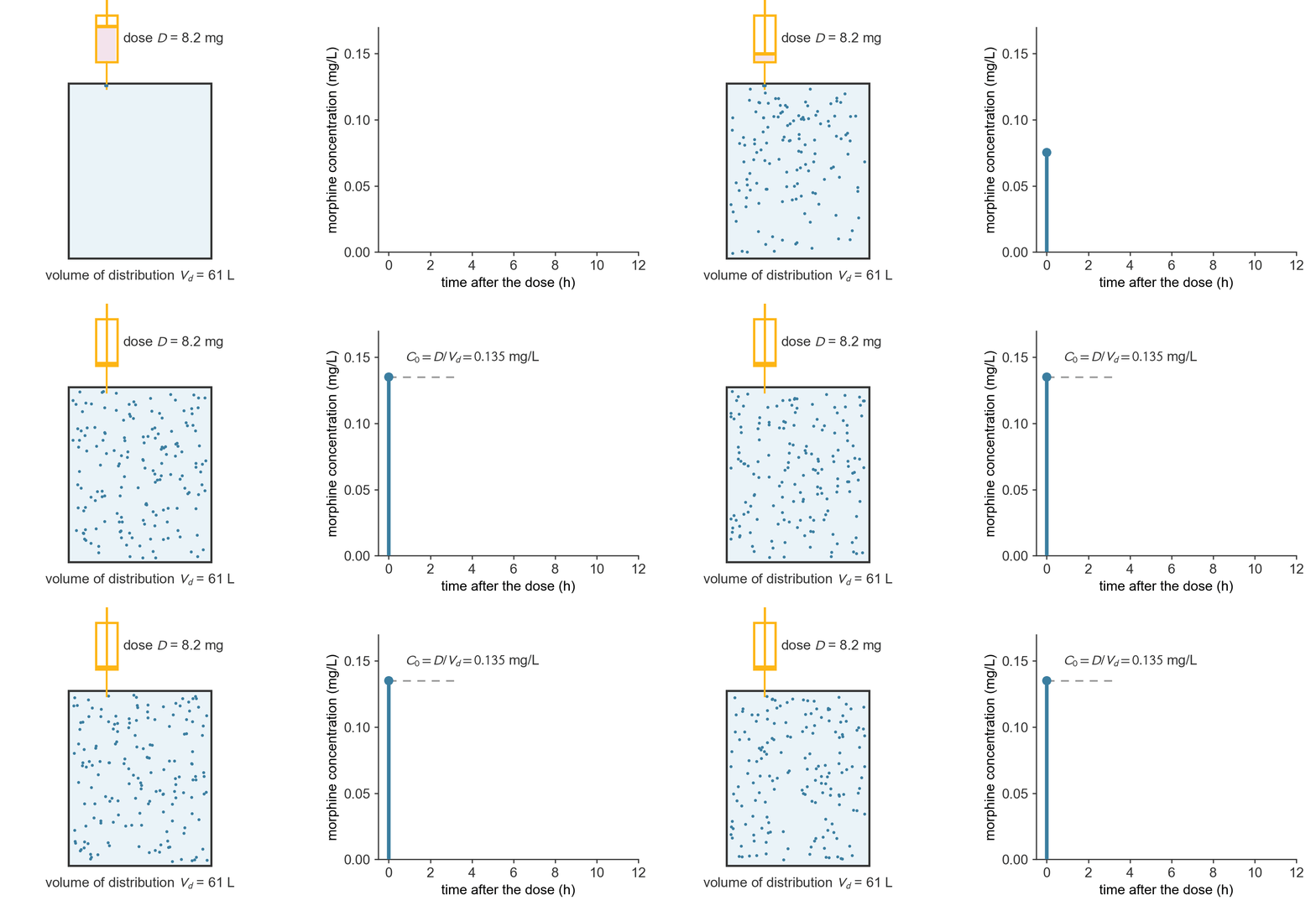
An intravenous (IV) bolus places a dose \(D\) directly into the blood in a single, effectively instantaneous injection, so the whole dose reaches the compartment (Grogan and Preuss 2023). No absorption step is modeled. The input is an initial condition rather than a continuing rate: at \(t=0\) the whole dose is present, and for \(t>0\) the compartment only loses drug. The concentration immediately after injection (Figure 33.2) is the dose divided by the volume it distributes into,
\[C_0 = \frac{D}{V_d}.\]
The mass balance. A boundary is drawn around the compartment and everything that crosses it is counted. The mass of drug inside changes only because drug enters or leaves, where leaving includes chemical breakdown (metabolism). Writing \(\dot m\) for a mass per unit time (mg/h), which can change with time:
\[\frac{\Delta\,\text{mass}_{\text{drug}}}{\Delta t} = \dot m_{\text{in}} - \dot m_{\text{out}} .\]
How fast is a drug removed? The rate law
To use the mass balance, the dependence of the removal rate on the concentration must be known. A rate law states it:
\[r = k\,C^{\,n}\]
where \(r\) is the rate of removal per unit volume (concentration/time), \(k\) is the rate constant (units depend on \(n\)), and \(n\) is the order, a unitless number that sets how strongly the rate depends on concentration. The order is measured by experiment. Orders 0 and 1 are used here:
| order \(n\) | rate law | double \(C\), and the rate… | units of \(k\) |
|---|---|---|---|
| 0 | \(r = k\) | stays the same | concentration/time |
| 1 | \(r = kC\) | doubles | 1/time |
The units of \(k\) follow from requiring \(r\) to have units of concentration per time.
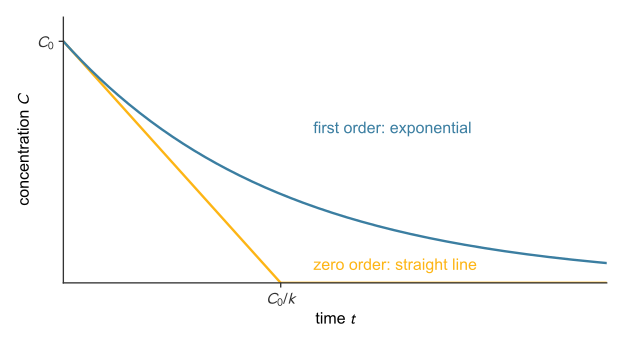
Zero order (\(n = 0\)). The rate does not depend on concentration: \(dC/dt = -k\), so \(C = C_0 - kt\). The same amount disappears in every unit of time, so the concentration falls in a straight line and reaches zero at \(t = C_0/k\). The units of \(k\) are concentration per time (mg/(L·h)).
First order (\(n = 1\)). The rate is proportional to concentration: \(dC/dt = -kC\). Each molecule has the same chance of being removed in each instant, so twice as many molecules are removed twice as fast. As the drug is removed, removal slows (Figure 33.3). The units of \(k\) are 1/time (1/h).
For morphine, first-order elimination is used: the removal rate is \(k_e C\) per unit volume, with \(k_e\) in 1/h. Most drugs behave this way at therapeutic concentrations, because the body’s removal machinery (liver enzymes and kidney transport) is far from fully occupied, so removal stays proportional to the amount of drug present (Hallare and Gerriets 2025).
What is \(V_d\)? The volume of distribution
The dose \(D\) is known and the concentration \(C_0\) is measured, but the volume the drug mixes into is not obvious: the sample is blood, and the drug may not stay in the blood.
Right after an intravenous dose \(D\) has mixed, the amount in the body is \(D\) and the concentration is \(C_0\), so \(V_d = D/C_0\). This is how \(V_d\) is measured: inject a known dose, sample the plasma, divide. This is \(C_0 = D/V_d\) solved for \(V_d\).
A tank and a sponge. A dose \(D = 100\) mg is dissolved in a tank holding 10 L of water. The drug spreads evenly, so a sample reads \(C = 10\) mg/L, and \(V_d = D/C = (100~\text{mg})/(10~\text{mg/L}) = 10\) L: here the volume of distribution is the volume of the tank. Now a sponge is added that soaks up 90 of the 100 mg. The water holds only 10 mg, so a sample reads \(C = 1\) mg/L, and \(V_d = (100~\text{mg})/(1~\text{mg/L}) = 100\) L, ten times the tank. \(V_d\) does not represent a true physical volume. It converts between the amount of drug in the body and the concentration measured in the plasma.
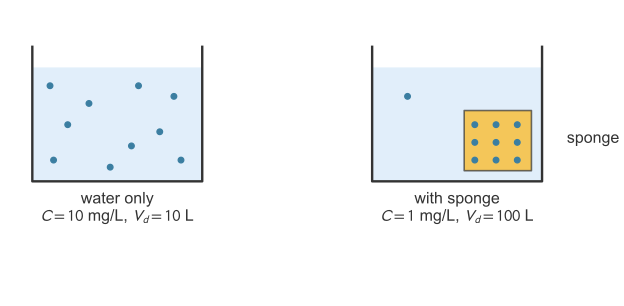
In the body, tissues play the role of the sponge (Figure 33.4). A drug confined to the plasma has a small \(V_d\), of order the plasma volume (about 3 L in an adult). A drug that tissues take up leaves little in the plasma, so its \(V_d\) can exceed the volume of the whole body (Bisht et al. 2026). For comparison, the total body water of a 70 kg adult is about 42 L.
The mass balance for a bolus
The balance below holds for any drug eliminated by first-order kinetics from a single well-mixed compartment after a bolus. The whole dose is injected at \(t = 0\) and sets the starting concentration \(C_0\). After that nothing more enters, so for every \(t > 0\), \(\dot m_{\text{in}} = 0\) and
\[\frac{\Delta\,\text{mass}}{\Delta t} = -\dot m_{\text{out}} .\]
The mass in the compartment is \(C V_d\), and first-order removal takes out \(k_e C\) per unit volume, so \(k_e C V_d\) in total:
\[\frac{\Delta (C V_d)}{\Delta t} = -k_e\,C\,V_d .\]
Check the units.
Left side: \((\text{mg/L})(\text{L})/\text{h} = \text{mg/h}\). Right side: \((1/\text{h})(\text{mg/L})(\text{L}) = \text{mg/h}\).
Check by substitution. \(\dfrac{dC}{dt} = -k_e C_0\,e^{-k_e t} = -k_e\,C\), and at \(t = 0\), \(C = C_0\).
Taking the natural logarithm of the solution gives a second form,
\[\ln C(t) = \ln C_0 - k_e\,t .\]
Watching the decay
Drug is eliminated at a rate proportional to the amount present (Figure 33.5). Many dots are removed per hour at first and fewer later, so the concentration falls steeply and then flattens.
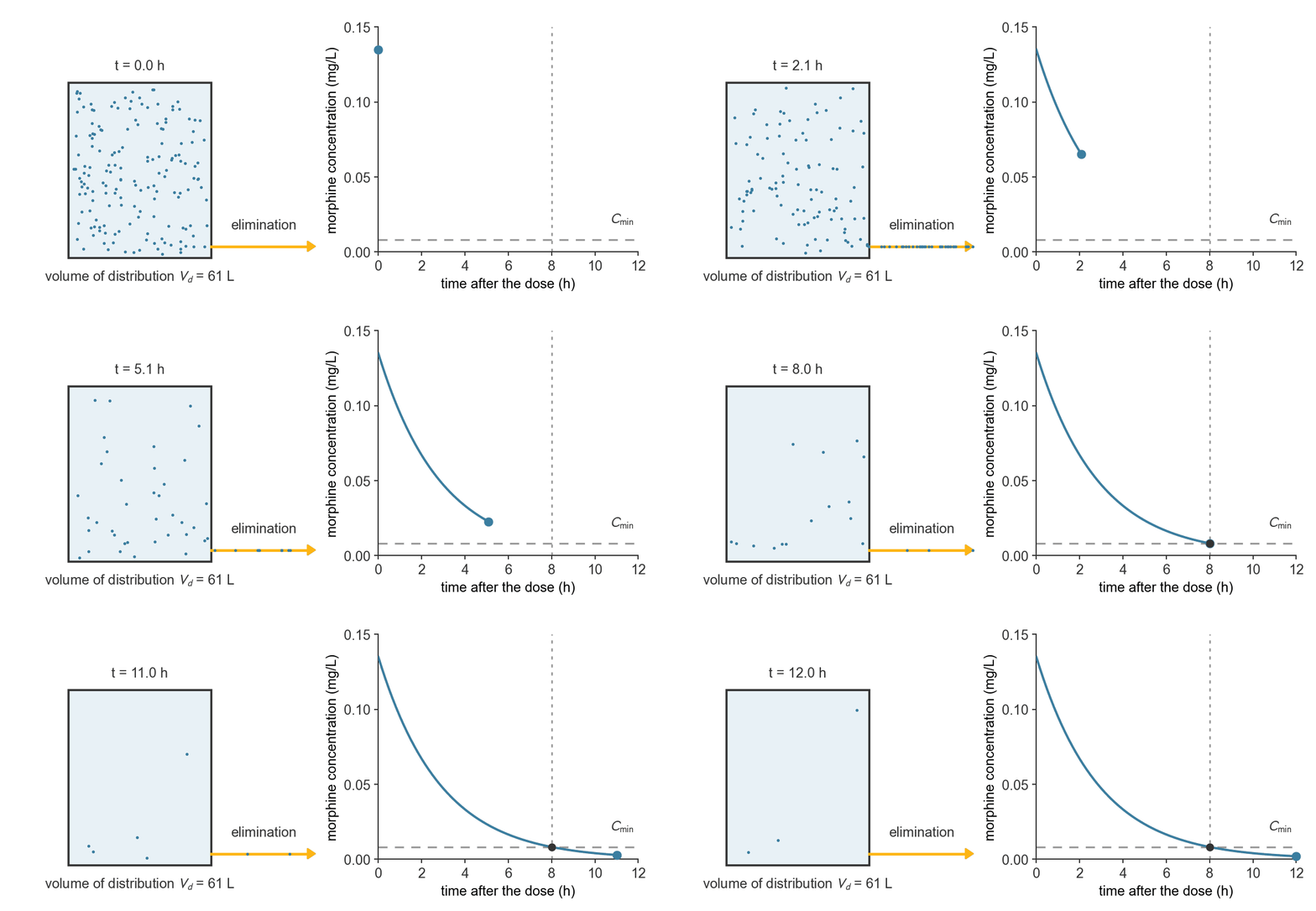
In Figure 33.6, move the slider to change the elimination rate constant \(k_e\). The starting concentration is fixed at \(C_0 = 0.135\) mg/L, so the same dose is given each time. A larger \(k_e\) lowers the concentration faster, so it drops below \(C_{\min}\) sooner.
Half-life
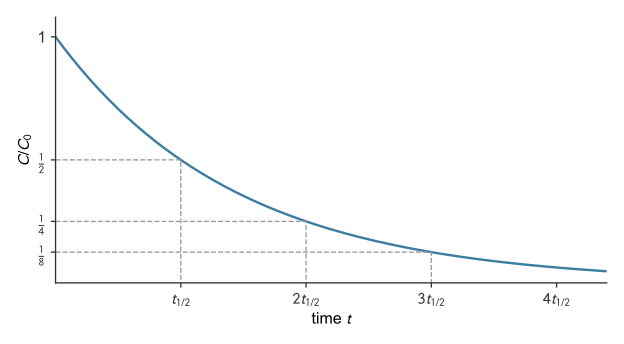
The elimination half-life \(t_{1/2}\) is the time for half of the drug to be removed, \(C(t_{1/2}) = C_0/2\):
\[\frac{C_0}{2} = C_0\,e^{-k_e t_{1/2}} \;\Longrightarrow\; \tfrac{1}{2} = e^{-k_e t_{1/2}} \;\Longrightarrow\; k_e\,t_{1/2} = \ln 2,\]
so
\[\boxed{\,t_{1/2} = \dfrac{\ln 2}{k_e} \approx \dfrac{0.693}{k_e}\,}.\]
\(C_0\) cancels: the half-life does not depend on how much drug is present (Hallare and Gerriets 2025). After \(n\) half-lives the fraction remaining is \((1/2)^n\), whatever the dose. A constant half-life exists only for first-order removal; for zero order, the time to remove half depends on how much was present at the start.
| Half-lives elapsed | Fraction remaining |
|---|---|
| 1 | \(1/2 = 50\%\) |
| 2 | \(1/4 = 25\%\) |
| 3 | \(1/8 = 12.5\%\) |
| 4 | \(1/16 = 6.25\%\) |
| 5 | \(1/32 \approx 3.1\%\) |
After four to five half-lives (Figure 33.7) roughly 94–97% of the drug has gone, and the plasma concentration has usually dropped below any clinically relevant level, so the drug is treated as effectively eliminated (Hallare and Gerriets 2025).
Morphine. The morphine problem has \(k_e = 0.35\) h\(^{-1}\):
\[t_{1/2} = \frac{0.693}{0.35~\text{h}^{-1}} = 1.98~\text{h}.\]
The FDA label for intravenous morphine gives an elimination half-life of 1.5 to 2 h in normal subjects and a volume of distribution of 1 to 4.7 L/kg (Hospira, Inc. 2006). The given values (\(k_e = 0.35\) h\(^{-1}\) here and \(V_d = 1\) L/kg below) lie within both ranges. Eight hours is about four half-lives.
How \(k_e\) is measured. Since \(\ln C = \ln C_0 - k_e\,t\), plotting \(\ln C\) against time gives a line with slope \(-k_e\) and intercept \(\ln C_0\). Fitting the line to plasma concentrations measured at a few times after a dose gives \(k_e\). A straight line in this plot also shows that elimination is first order. A logarithmic axis does the same job: each equal step along it multiplies the value by the same factor, so an exponential decay appears as a straight line.
What starting concentration is needed?
The concentration must stay at or above \(C_{\min}\) for 8 h. Concentration only falls, so it is enough that \(C(8~\text{h}) = C_{\min}\). The starting concentration \(C_0\) that gives \(C = 8.2\times10^{-3}\) mg/L at 8 h follows from
\[C_{\min} = C_0\,e^{-k_e t} \qquad\Longrightarrow\qquad C_0 = C_{\min}\,e^{k_e t}\]
\[C_0 = \left(8.2\times10^{-3}~\tfrac{\text{mg}}{\text{L}}\right)e^{(0.35~\text{h}^{-1})(8~\text{h})} = \left(8.2\times10^{-3}~\tfrac{\text{mg}}{\text{L}}\right)e^{2.8} = \left(8.2\times10^{-3}~\tfrac{\text{mg}}{\text{L}}\right)(16.44) = 0.135~\tfrac{\text{mg}}{\text{L}}.\]
Units. The exponent is \(\text{h}^{-1}\cdot\text{h}\), which is unitless.
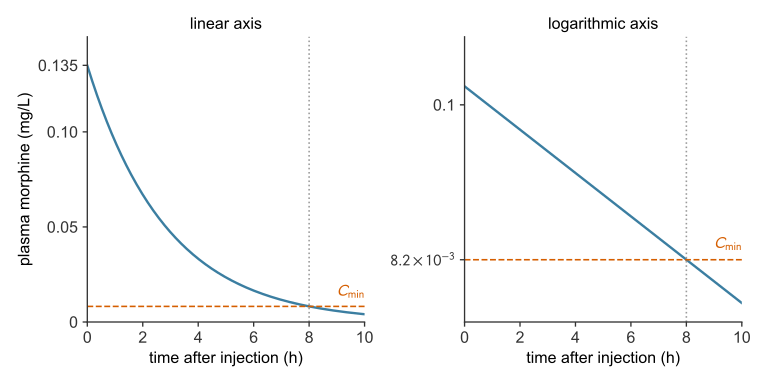
On the linear axis of Figure 33.8, the threshold lies close to zero and the curve flattens. On the logarithmic axis the same curve is a straight line that crosses \(C_{\min}\) at exactly 8 h.
How much to give
The dose is the starting concentration times the volume it fills, \(\text{dose} = C_0\,V_d\). The patient’s volume of distribution is the given value, \(V_d = (1~\text{L/kg})(61~\text{kg}) = 61\) L, so
\[\text{dose} = C_0\,V_d = \left(0.135~\tfrac{\text{mg}}{\text{L}}\right)(61~\text{L}) = 8.2~\text{mg}.\]
Loading the syringe. Everything in the syringe ends up in the patient, so the mass in the syringe equals the dose. The stock concentration \(C_{\text{stock}} = 10\) mg/mL sets the volume to draw up:
\[C_{\text{stock}}\,V_{\text{syringe}} = \text{dose} \qquad\Longrightarrow\qquad V_{\text{syringe}} = \frac{8.2~\text{mg}}{10~\text{mg/mL}} = 0.82~\text{mL}.\]
Why fast-cleared drugs need frequent dosing
The required starting concentration is \(C_0 = C_{\min}\,e^{k_e t}\). Writing \(k_e = \ln 2/t_{1/2}\),
\[\frac{C_0}{C_{\min}} = e^{k_e t} = 2^{\,t/t_{1/2}} .\]
Each additional half-life of relief doubles the dose. Eight hours is about four half-lives, so the starting concentration must be \(2^4 \approx 16\) times the threshold (more precisely, \(e^{2.8} = 16.4\)).
NoteOptional: two smaller doses instead of one large one
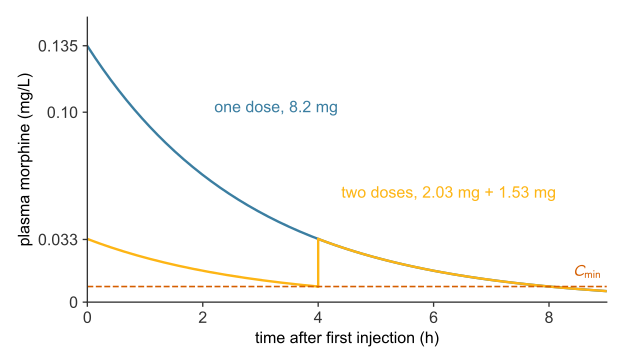
The same 8 h can be covered with two doses 4 h apart (same given values).
First dose. It must keep \(C \geq C_{\min}\) for 4 h: \(C_0 = C_{\min}e^{(0.35)(4)} = (8.2\times10^{-3})(4.06) = 0.0333\) mg/L, a dose of \((0.0333~\text{mg/L})(61~\text{L}) = 2.03\) mg.
Second dose, at 4 h, when \(C\) has fallen to \(C_{\min}\). It only has to raise \(C\) from \(C_{\min}\) back to 0.0333 mg/L, so it adds \((0.0333 - 0.0082)~\text{mg/L}\times 61~\text{L} = 1.53\) mg.
Comparison. Two doses use \(2.03 + 1.53 = 3.56\) mg in total, against 8.2 mg for one dose, and the highest concentration the patient sees is 0.033 mg/L instead of 0.135 mg/L, four times lower. The single dose must start about 16 times above \(C_{\min}\) so that it is still above it at 8 h, and most of that excess is eliminated unused. The first of two doses only has to last 4 h, and the second only has to cover the remaining 4 h (Figure 33.9).
Back to the question
The doctor loads 0.82 mL of the 10 mg/mL stock, which is 8.2 mg of morphine. The threshold \(C_{\min}\) and the rate constant \(k_e\) give \(C_0 = C_{\min}e^{k_e t}\), and \(V_d\) turns \(C_0\) into a dose.
Clearance
The rate constant \(k_e\) describes how fast the concentration falls, not the mass removed per unit time. The rate of removal is
\[\text{rate out} = k_e A = k_e V_d\,C .\]
The clearance \(CL\) is the rate of removal per unit concentration. It is the volume of plasma completely cleared of drug per unit time (for example, liters per hour) (Hallare and Gerriets 2025):
\[\boxed{\,CL = \frac{\text{rate out}}{C} = k_e\,V_d\,}\]
so the rate of elimination is \(CL \cdot C\).
Clearance separates two effects that \(k_e\) combines. Since \(k_e = CL/V_d\), a short half-life can arise from high clearance or from a small volume of distribution. Clearance also sets how much drug must be supplied per unit time to hold a target concentration. Renal clearance is treated in the kidney chapter.
Constant infusion and steady state
A constant intravenous infusion supplies drug at a fixed rate \(R\) (mg/h), so the mass balance has input \(R\) and output \(CL\cdot C\):
\[V_d\,\frac{dC}{dt} = R - CL\cdot C .\]
The concentration rises until elimination balances input, then holds steady. At this steady state \(dC/dt = 0\), so rate in = rate out:
\[R = CL \cdot C_{ss} \qquad\Longrightarrow\qquad C_{ss} = \frac{R}{CL} .\]
The approach to steady state follows from the same decay. Dividing the balance by \(V_d\) gives \(dC/dt = k_e\,(C_{ss} - C)\), so the gap \(C_{ss} - C\) decays with rate constant \(k_e\), as after a bolus. Starting from zero concentration,
\[C(t) = C_{ss}\left(1 - e^{-k_e t}\right).\]
After four to five half-lives the concentration has reached about 94–97% of \(C_{ss}\) (Hallare and Gerriets 2025).
These relations assume a single well-mixed compartment and first-order elimination. The iodine model adds a second compartment.
Exercises
References
Bisht, Supriya, Vikas Chauhan, and Preeti Patel. 2026. “Clinical Significance of Volume of Distribution in Pharmacotherapy.” In StatPearls. StatPearls Publishing. https://www.ncbi.nlm.nih.gov/books/NBK545280/.
Grogan, Sean, and Charles V. Preuss. 2023. “Pharmacokinetics.” In StatPearls. StatPearls Publishing. https://www.ncbi.nlm.nih.gov/books/NBK557744/.
Hallare, Jericho, and Valerie Gerriets. 2025. “Elimination Half-Life of Drugs.” In StatPearls. StatPearls Publishing. https://www.ncbi.nlm.nih.gov/books/NBK554498/.
Hospira, Inc. 2006. Preservative-Free Morphine Sulfate Injection, USP: Prescribing Information. FDA NDA 019916 label. https://www.accessdata.fda.gov/drugsatfda_docs/label/2006/019916s004lbl.pdf.