42  Flow: Viscosity and the Velocity Profile

Plaque, a deposit on the inner wall, has narrowed a long segment of artery to one quarter of its original diameter (Figure 42.1). Bernoulli’s equation neglects friction (conservation of energy), but friction sets the flow in a long, narrow vessel. The fall in flow is computed in Poiseuille’s law, from the velocity of the fluid across the vessel. How does the velocity of a fluid vary across a tube, and what sets the shear stress at the wall? The same tube model describes liquid in the pores of a test strip (capillary flow).
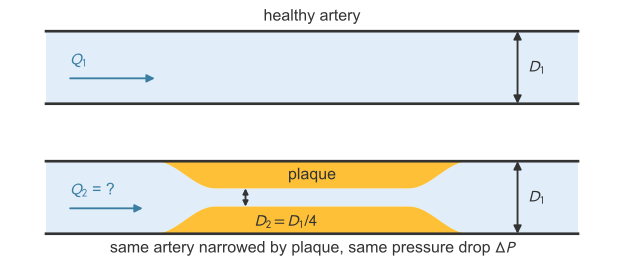
Two horizontal tubes: a healthy artery of diameter D1 on top, and below it the same artery with gold plaque narrowing a long middle segment to one quarter of that diameter.
Figure 42.1: A healthy artery (top) and the same artery narrowed by plaque to one quarter of its diameter (bottom), with the same pressure drop \(\Delta P\) across each.

Viscosity

In the experiment of Figure 42.2, fluid fills a gap of depth \(d\) between a stationary plate and a plate of area \(A\) moving at constant speed \(v\). Fluid in contact with a solid surface moves with that surface, a rule called the no-slip condition (Urone and Hinrichs 2022). The fluid is therefore at rest against the stationary plate and moves at \(v\) against the moving one. Each layer drags the one below it, and the velocity rises in a straight line between the two.

The fluid resists this sliding and pulls back on the moving plate. Keeping the plate at constant speed takes a force (Urone and Hinrichs 2022)

\[F = \mu A\,\frac{v}{d}.\]

The constant \(\mu\) (mu) is the viscosity, the fluid’s resistance to neighboring layers sliding past one another, in pascal-seconds (Pa·s). It is a property of the fluid, so a value measured between plates applies to any flow of that fluid. Water at 20 °C has \(\mu = 1.0\times10^{-3}\) Pa·s, and honey is 2000 to 10,000 times more viscous (Urone and Hinrichs 2022).
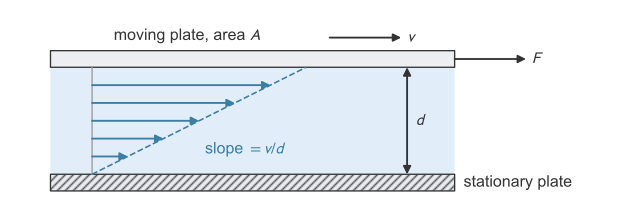
Fluid between a fixed lower plate and an upper plate pulled to the right by a force F; arrows in the fluid grow in proportion to height, from zero at the bottom to the plate speed v at the top.
Figure 42.2: The two-plate experiment. A force \(F\) keeps the top plate moving at speed \(v\). The fluid layers (arrows, to scale) move faster with height, from zero at the stationary plate to \(v\) at the moving plate. The dashed line marks the slope \(v/d\).

Shear stress and Newton’s law of viscosity

A tube has no plates, and the velocity in it changes continuously from the center line to the wall. Dividing the plate force by the area it acts on gives a quantity defined at any point in a fluid. This is the shear stress \(\tau\) (tau), a force per area acting along a surface:

\[\tau = \frac{F}{A} = \mu\,\frac{v}{d}.\]

Shear stress has the units of pressure (Pa). Pressure pushes perpendicular to a surface; shear stress drags along it. The ratio \(v/d\), in (m/s)/m = 1/s, is the slope of the velocity profile (the dashed line in Figure 42.2) and is called the shear rate.

A curved profile is nearly straight over a thin slab of thickness \(\Delta y\). The slab then behaves as a small plate experiment, \(\tau = \mu\,\Delta v/\Delta y\), and letting \(\Delta y \to 0\) gives the slope at a point:

NoteNewton’s law of viscosity

\[\tau = \mu\,\frac{dv}{dy}\]

Shear stress (Pa) equals viscosity (Pa·s) times the shear rate \(dv/dy\) (1/s), the local slope of the velocity profile.

Viscous stress therefore depends on how fast the velocity changes between layers, not on how fast the fluid moves. Fluid moving as a rigid block at 1 m/s has \(dv/dy = 0\) and no shear stress between its layers.

Flow in a tube

A straight tube of radius \(R\) and length \(L\) has pressure \(P_0\) at the inlet and \(P_L\) at the outlet (Figure 42.3). The pressure drop \(\Delta P = P_0 - P_L\) drives fluid along the tube, in the \(z\) direction. At distance \(r\) from the center line the fluid moves at velocity \(v_z(r)\). The unknowns are this velocity profile and the volumetric flow rate \(Q\) (m³/s), the volume crossing the tube per second (conservation of mass).

The fluid is taken to be incompressible, meaning its density does not change under pressure, and Newtonian, meaning its viscosity is the same at every shear rate. Blood is only approximately Newtonian, because its viscosity depends on shear rate at low shear rates; a constant \(\mu\) gives an estimate of flow in a large artery, not an exact model (Secomb 2016). The flow is laminar, moving straight down the tube in smooth layers without mixing, and steady, with the same profile at every \(z\), so no fluid accelerates. The tube is round, straight, horizontal, and of constant radius, and the fluid does not slip at the wall: \(v_z(R) = 0\).

The Reynolds number, \(\mathrm{Re} = \rho\bar v D/\mu\), the ratio of inertial to viscous forces, predicts whether flow is laminar (Squires and Quake 2005). Here \(\rho\) is the density, \(\bar v\) the mean velocity (flow rate divided by cross-sectional area) and \(D\) the tube diameter. Flow in a tube is laminar for Re below about 2000 and turbulent above about 3000. Between about 2000 and 3000 the flow is transitional: small disturbances, such as wall roughness, can make it turbulent (Urone and Hinrichs 2022, sec. 12.5).

Water (\(\rho = 1000\) kg/m³) moving at 1 mm/s in a 100 µm channel has \(\mathrm{Re} = (1000)(10^{-3})(10^{-4})/10^{-3} = 0.1\). At 2 m/s in a 1.5 cm garden hose, \(\mathrm{Re} = 3\times10^{4}\), and the flow is turbulent. Flow in small channels, such as those of microfluidic devices, is typically laminar (Squires and Quake 2005).

The velocity profile from a force balance

Consider an imaginary cylinder of fluid of radius \(r\), centered on the axis and running the full length \(L\) of the tube (Figure 42.3). Its velocity does not change, so the forces on it add to zero (Bird et al. 2002).
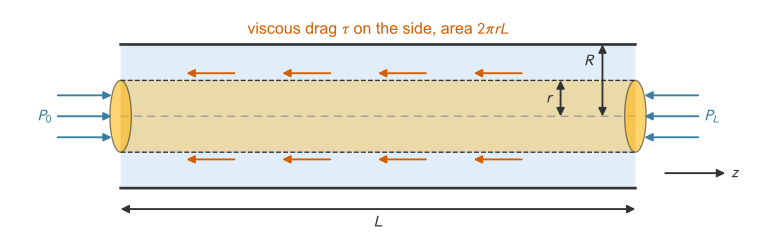
A tube of radius R and length L containing a coaxial gold cylinder of fluid of radius r, with pressure arrows P0 and PL pushing on its two ends and backward drag arrows along its side.
Figure 42.3: Forces on a cylinder of fluid (gold) of radius \(r\) in a tube of radius \(R\): pressure on the two end faces and viscous drag on the side.
NoteDerivation — Velocity profile in a tube

Force balance. Pressure acts on the two end faces, each of area \(\pi r^2\), for a net forward force \((P_0 - P_L)\,\pi r^2 = \Delta P\,\pi r^2\). The slower fluid outside drags backward on the side, of area \(2\pi r L\), with force \(\tau \cdot 2\pi r L\), the shear stress times the area. Setting the two equal,

\[\Delta P\,\pi r^2 = \tau \cdot 2\pi r L \qquad\Longrightarrow\qquad \tau(r) = \frac{\Delta P}{2L}\,r .\]

From shear stress to velocity. The fluid layers in a tube are nested cylindrical shells, so the height \(y\) in Newton’s law of viscosity becomes the radius \(r\), with a minus sign because the velocity decreases outward:

\[\tau(r) = -\mu\,\frac{dv_z}{dr} \qquad\Longrightarrow\qquad \frac{dv_z}{dr} = -\frac{\Delta P}{2\mu L}\,r .\]

Integrate and apply no slip. Integrating once, \(v_z(r) = -\Delta P\,r^2/(4\mu L) + K\), where \(K\) is a constant of integration. No slip, \(v_z(R) = 0\), gives \(K = \Delta P\,R^2/(4\mu L)\), so

\[v_z(r) = \frac{\Delta P}{4\mu L}\left(R^2 - r^2\right).\]

The parabolic profile

The velocity depends on \(r\) alone, so fluid anywhere on a ring around the axis moves at one speed. It is largest on the axis,

\[v_{\max} = \frac{\Delta P\,R^2}{4\mu L},\]

and falls to zero at the wall, tracing a parabola (Figure 42.4). The whole profile scales with \(\Delta P/\mu\): doubling the pressure drop doubles every velocity, and doubling the viscosity halves it.
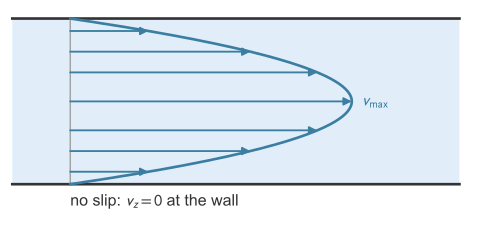
Side view of a tube with horizontal velocity arrows whose tips trace a parabola, longest on the axis and shrinking to zero at the walls.
Figure 42.4: Side view of a tube. Velocity arrows, drawn to scale, trace a parabola: the velocity is largest on the axis and zero at the wall.

The shear stress from the force balance, \(\tau(r) = \Delta P\,r/(2L)\), varies the opposite way (Figure 42.5): it is zero on the axis, where the profile is flat, and largest at the wall, where the profile is steepest. At the wall it reaches \(\tau_w = \Delta P\,R/(2L)\), set by the pressure drop per unit length and the tube radius. At a given \(\Delta P\), a more viscous fluid moves more slowly but exerts the same stress on the wall.
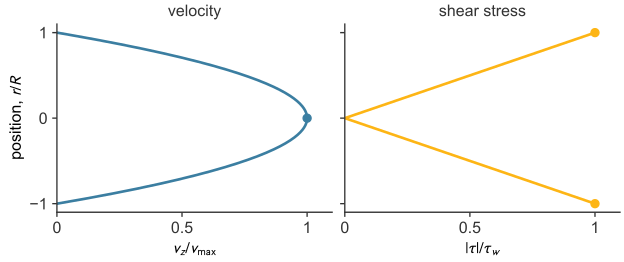
Two plots against position across the tube: the velocity is a parabola that peaks on the axis, and the shear-stress magnitude is a V shape, zero on the axis and largest at the walls.
Figure 42.5: Velocity and the magnitude of the shear stress across a tube, wall to wall (negative \(r/R\) is the far side of the axis); \(\tau_w\) is the shear stress at the wall.

Example: a water-filled tube

Water (\(\mu = 1.0\times10^{-3}\) Pa·s, \(\rho = 1000\) kg/m³) flows through a tube of radius \(R = 0.5\) mm and length \(L = 10\) cm under a pressure drop \(\Delta P = 20\) Pa. The velocity on the axis is

\[v_{\max} = \frac{\Delta P\,R^2}{4\mu L} = \frac{(20)(5.0\times10^{-4})^2}{4\,(1.0\times10^{-3})(0.10)} = 0.0125~\text{m/s} = 12.5~\text{mm/s},\]

and the shear stress at the wall is

\[\tau_w = \frac{\Delta P\,R}{2L} = \frac{(20)(5.0\times10^{-4})}{2\,(0.10)} = 0.050~\text{Pa}.\]

No fluid moves faster than \(v_{\max}\), so the mean velocity is below 12.5 mm/s and the Reynolds number is below

\[\frac{\rho\,v_{\max}D}{\mu} = \frac{(1000)(0.0125)(1.0\times10^{-3})}{1.0\times10^{-3}} = 12.5,\]

far below 2000. The flow is laminar, as the model assumes.

Steady laminar flow in a tube has a parabolic velocity profile and a shear stress that is largest at the wall, \(\tau_w = \Delta P\,R/(2L)\). Poiseuille’s law turns this profile into the flow rate.

Exercises

Unless stated otherwise, the fluid is water, with \(\mu = 1.0\times10^{-3}\) Pa·s and \(\rho = 1000\) kg/m³.

TipProblem 1

A plate of area \(A = 0.01\) m² slides at \(v = 1\) cm/s over a 1 mm layer of fluid with \(\mu = 1\) Pa·s. Find the shear stress on the plate and the force needed to keep it moving.

\(\tau = \mu v/d = (1~\text{Pa·s})(0.01~\text{m/s})/(0.001~\text{m}) = 10\) Pa, and \(F = \tau A = (10~\text{Pa})(0.01~\text{m}^2) = 0.1\) N.

TipProblem 2

A glass capillary tube of inner radius 0.25 mm and length 10 cm carries water under a pressure drop of 100 Pa.

  1. Find the velocity on the axis.
  2. Find the velocity and the shear stress halfway to the wall, at \(r = R/2\).
  3. Where in the tube is the shear stress largest, and what is its value there?
  4. The water is replaced by a liquid three times as viscous, and the pressure drop is doubled. Find the new velocity on the axis.
  1. \(v_{\max} = \dfrac{\Delta P\,R^2}{4\mu L} = \dfrac{(100)(2.5\times10^{-4})^2}{4(10^{-3})(0.10)} = 0.0156\) m/s \(= 15.6\) mm/s.
  2. \(v_z(R/2) = v_{\max}\big(1 - \tfrac{1}{4}\big) = 11.7\) mm/s, and \(\tau(R/2) = \dfrac{\Delta P\,(R/2)}{2L} = \dfrac{(100)(1.25\times10^{-4})}{2(0.10)} = 0.0625\) Pa.
  3. At the wall, \(r = R\): \(\tau = \Delta P\,R/(2L) = 0.125\) Pa. On the axis \(\tau = 0\).
  4. \(v_{\max} \propto \Delta P/\mu\), so it changes by a factor \(2/3\), to 10.4 mm/s.
TipProblem 3
  1. Differentiate the velocity profile \(v_z(r) = \Delta P\,(R^2 - r^2)/(4\mu L)\) and use \(\tau = -\mu\,dv_z/dr\) to recover the force-balance result \(\tau(r) = \Delta P\,r/(2L)\).
  2. Show that the shear rate at the wall, \(|dv_z/dr|\) at \(r = R\), equals \(2v_{\max}/R\). Compare it with \(v_{\max}/R\), the slope of a straight-line profile that falls from \(v_{\max}\) on the axis to zero at the wall.
  1. \(\dfrac{dv_z}{dr} = -\dfrac{2r\,\Delta P}{4\mu L} = -\dfrac{\Delta P\,r}{2\mu L}\), so \(\tau = -\mu\,\dfrac{dv_z}{dr} = \dfrac{\Delta P\,r}{2L}\).
  2. At \(r = R\), \(|dv_z/dr| = \Delta P\,R/(2\mu L)\). With \(v_{\max} = \Delta P\,R^2/(4\mu L)\), \(2v_{\max}/R = \Delta P\,R/(2\mu L)\), the same. The parabola is twice as steep at the wall as the straight line.
TipProblem 4

Water flows at a mean velocity of 1 cm/s through a microfluidic channel 200 µm in diameter.

  1. Find the Reynolds number. Is the flow laminar?
  2. What mean velocity would bring the Reynolds number to 2000 in this channel?
  1. \(\mathrm{Re} = \rho\bar v D/\mu = (1000)(0.01)(2.0\times10^{-4})/(1.0\times10^{-3}) = 2\), far below 2000: laminar.
  2. \(\bar v = \mathrm{Re}\,\mu/(\rho D) = (2000)(1.0\times10^{-3})/\big((1000)(2.0\times10^{-4})\big) = 10\) m/s, a thousand times faster. Flow in a channel this narrow stays laminar at any speed below about 10 m/s.

References

Bird, R. Byron, Warren E. Stewart, and Edwin N. Lightfoot. 2002. Transport Phenomena. 2nd ed. John Wiley & Sons.
Secomb, Timothy W. 2016. “Hemodynamics.” Comprehensive Physiology 6: 975–1003. https://doi.org/10.1002/cphy.c150038.
Squires, Todd M., and Stephen R. Quake. 2005. “Microfluidics: Fluid Physics at the Nanoliter Scale.” Reviews of Modern Physics 77 (3): 977–1026. https://doi.org/10.1103/RevModPhys.77.977.
Urone, Paul Peter, and Roger Hinrichs. 2022. College Physics 2e. OpenStax, Rice University. https://openstax.org/books/college-physics-2e/pages/12-4-viscosity-and-laminar-flow-poiseuilles-law.