43 Flow Rate: Poiseuille’s Law
Plaque has narrowed a long segment of artery to one quarter of its original diameter (Figure 42.1). If the pressure drop across the segment stays the same, how much does blood flow fall? Summing the parabolic velocity profile of steady laminar tube flow, \(v_z(r) = \Delta P\,(R^2 - r^2)/(4\mu L)\) (flow), over the cross-section gives the volumetric flow rate \(Q\).
Flow rate from the velocity profile
If all the fluid moved at one speed \(v\), the flow rate would be \(Q = vA\), the speed times the cross-sectional area. In a tube the velocity varies with \(r\), so the flow through each small piece of the cross-section is summed as an integral (integrals as accumulation), \(Q = \int v_z\,dA\). Because \(v_z\) is constant around a ring, the pieces are taken to be thin rings. A ring of radius \(r\) and width \(dr\) unrolls into a strip of length \(2\pi r\) and width \(dr\) (Figure 43.1), so its area is \(dA = 2\pi r\,dr\).
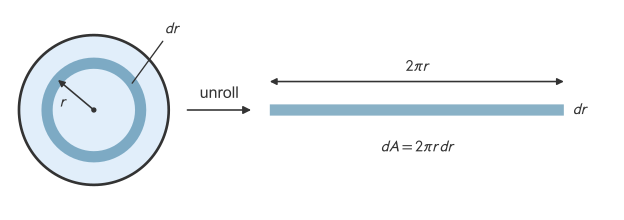
Summing the rings from the axis to the wall gives
\[Q = \int_0^R \frac{\Delta P}{4\mu L}\left(R^2 - r^2\right) 2\pi r\,dr = \frac{\pi\,\Delta P}{2\mu L}\left[\frac{R^2 r^2}{2} - \frac{r^4}{4}\right]_0^R = \frac{\pi\,\Delta P}{2\mu L}\cdot\frac{R^4}{4}.\]
Dividing \(Q\) by the area \(\pi R^2\) gives the mean velocity, half the velocity on the axis:
\[\bar v = \frac{Q}{\pi R^2} = \frac{\Delta P\,R^2}{8\mu L} = \frac{v_{\max}}{2}.\]
The fourth power and hydraulic resistance
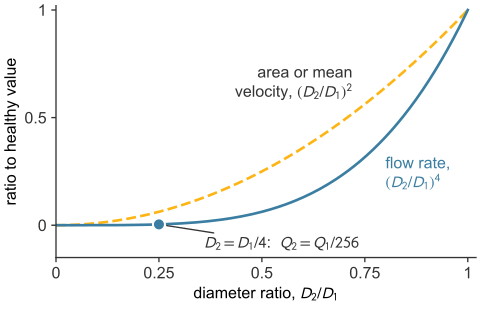
The flow rate scales with the fourth power of the radius. Halving \(R\) at a fixed pressure drop divides the flow by \(2^4 = 16\), because the mean velocity falls fourfold (\(\bar v \propto R^2\)) and so does the area that carries it (Figure 43.2). Delivering the same flow through a tube of half the radius takes 16 times the pressure drop.
In an electrical circuit, Ohm’s law states that the voltage \(V\) across a resistor equals the current \(i\) through it times its resistance \(R_{\text{elec}}\): \(V = iR_{\text{elec}}\) (Ling et al. 2016). Rearranged, Poiseuille’s law has the same form:
\[\Delta P = R_{\text{hyd}}\,Q, \qquad R_{\text{hyd}} = \frac{8\mu L}{\pi R^4}.\]
Pressure drop plays the role of voltage, flow rate the role of current, and the hydraulic resistance \(R_{\text{hyd}}\) (Pa·s/m³) the role of electrical resistance (Urone and Hinrichs 2022). Doubling the pressure drop doubles the flow, while widening the tube by 20% multiplies it by \(1.2^4 = 2.07\). Tubes joined end to end carry the same \(Q\), and their pressure drops add, so their hydraulic resistances add, like electrical resistors in a series circuit.
Wall shear stress
At the wall, \(r = R\), the shear stress is
\[\tau_w = \frac{\Delta P\,R}{2L} = \frac{4\mu Q}{\pi R^3},\]
where the second form uses Poiseuille’s law (Problem 2). Endothelial cells, the cells that line the inside of a blood vessel in a single layer (Betts et al. 2022), sit at the wall, where the shear stress is largest, and respond to it. The wall shear stress typical of healthy arteries, called arterial-level shear stress, is above about 1.5 Pa (Malek et al. 1999). Atherosclerosis, the build-up of plaque, develops preferentially at sites of low wall shear stress, typically below about 0.4 Pa, such as the outer edges of vessel branch points (Malek et al. 1999).
Example: shear stress in a microfluidic channel
Water is pumped at \(Q = 1~\mu\)L/min through a round channel of radius \(R = 50~\mu\)m and length \(L = 2\) cm. What pressure drop must the pump supply, and what shear stress acts on the wall? With \(1~\mu\text{L} = 10^{-9}~\text{m}^3 = 10^{-6}\) L, the flow rate is \(Q = (10^{-9}~\text{m}^3)/(60~\text{s}) = 1.67\times10^{-11}\) m³/s, and \(1~\text{m}^3/\text{s} = 6\times10^{10}~\mu\)L/min.
import numpy as np

mu = 1.0e-3                            # viscosity of water, Pa*s
Q = 1e-9 / 60                          # 1 uL/min in m^3/s
R, L = 50e-6, 0.02                     # radius and length, m

dP = 8 * mu * L * Q / (np.pi * R**4)   # Poiseuille's law, Pa
tau_w = dP * R / (2 * L)               # wall shear stress, Pa
print(f"dP = {dP:.0f} Pa, tau_w = {tau_w:.2f} Pa")
which prints
dP = 136 Pa, tau_w = 0.17 PaThe pump must supply about 136 Pa. The wall shear stress, 0.17 Pa, is below the 0.4 Pa low-shear level. Endothelial cells grown in this channel would therefore experience the shear stress of plaque-prone regions rather than that of a healthy artery (Malek et al. 1999). Because \(\tau_w \propto Q\), raising the flow rate raises the shear stress in proportion (Problem 4).
The sliders in Figure 43.3 change \(\Delta P\), \(\mu\) and \(L\). They start at the example’s values (water, \(\mu = 1\) mPa·s, at \(\Delta P = 136\) Pa in a channel 2 cm long), where the readout below the figure gives \(Q = 1.00\) µL/min and \(\tau_w = 0.170\) Pa. Raising \(\mu\) slows the flow but leaves \(\tau_w\) unchanged.
The narrowed artery
The narrowed segment is modeled as a uniform tube of diameter \(D_2\), with the same length, blood, and pressure drop as the original segment of diameter \(D_1\) (Figure 42.1). With \(R = D/2\) in Poiseuille’s law, every factor except the diameter cancels:
\[\frac{Q_1}{Q_2} = \frac{\pi\,(D_1/2)^4\,\Delta P/(8\mu L)}{\pi\,(D_2/2)^4\,\Delta P/(8\mu L)} = \left(\frac{D_1}{D_2}\right)^4 = 4^4 = 256 .\]
The narrowed segment carries \(1/256\) of its original flow, about 0.4% (Figure 43.2, at \(D_2/D_1 = 0.25\)); restoring that flow takes a pressure drop 256 times larger. The uniform-tube model gives the scaling with diameter, not a clinical prediction. Flow through the pores of a test strip has the same fourth-power dependence on radius, but there the pore radius also sets the driving pressure (capillary flow).
Exercises
Unless stated otherwise, the fluid is water, with \(\mu = 1.0\times10^{-3}\) Pa·s and \(\rho = 1000\) kg/m³.
References
Betts, J. Gordon, Kelly A. Young, James A. Wise, et al. 2022. Anatomy and Physiology 2e. OpenStax, Rice University. https://med.libretexts.org/Bookshelves/Anatomy_and_Physiology/Anatomy_and_Physiology_2e_(OpenStax).
Ling, Samuel J., Jeff Sanny, and William Moebs. 2016. University Physics Volume 2. OpenStax, Rice University. https://phys.libretexts.org/Bookshelves/University_Physics/University_Physics_(OpenStax)/University_Physics_II_-_Thermodynamics_Electricity_and_Magnetism_(OpenStax)/10:_Direct-Current_Circuits/10.06:_RC_Circuits.
Malek, Adel M., Seth L. Alper, and Seigo Izumo. 1999. “Hemodynamic Shear Stress and Its Role in Atherosclerosis.” JAMA 282 (21): 2035–42. https://doi.org/10.1001/jama.282.21.2035.
Urone, Paul Peter, and Roger Hinrichs. 2022. College Physics 2e. OpenStax, Rice University. https://openstax.org/books/college-physics-2e/pages/12-4-viscosity-and-laminar-flow-poiseuilles-law.