These problems apply the single-compartment model. After a rapid intravenous dose the plasma concentration decays exponentially,
\[
c(t) = c_0\,e^{-kt},
\]
where \(c_0\) is the concentration immediately after injection and \(k\) is the first-order elimination rate constant (Grogan and Preuss 2023). Two relations recur throughout: the initial concentration is fixed by the injected dose \(D\) and the volume of distribution, \(c_0 = D/V_d\)(Bisht et al. 2026), and the elimination half-life and clearance follow from \(k\) as \(t_{1/2} = \ln 2 / k\) and \(CL = k\,V_d\)(Hallare and Gerriets 2025).
Work each problem before revealing its answer.
These are one-compartment drills. For two-compartment behavior, use the exercises in iodine metabolism.
TipProblem 1: Morphine metabolism
Figure 36.1: Single-compartment model of the blood: a drug at initial concentration C_0 distributes into a volume of distribution V_d and is eliminated at rate k_e.
A doctor must give a patient the correct dose of morphine, modeled with the single-compartment picture in Figure 36.1, to relieve post-surgical pain during sleep (8 hours). The following is known about the patient:
The patient weighs 61 kg
The volume of distribution for morphine \(V_{d, \text { morphine }}\) is approximately 1.0 \(\mathrm{L} / \mathrm{kg}\), or 61 L (for this 61 kg patient).
This patient’s elimination rate constant for morphine is \(k=0.351 / \mathrm{hr}\).
The threshold for pain is \(8.2 \times 10^{-3} \frac{mg}{L}\)
How much morphine should be given to the patient before bed so that the concentration of morphine in their system doesn’t drop below the pain-relieving concentration? That is, find \(\mathrm{C}_{0}\).
How much should the doctor inject to achieve this initial dose?
NoteAnswer 1
How much morphine should be given to the patient before bed?
How much morphine should be given to the patient before bed so that the concentration of morphine in their system doesn’t drop below the pain-relieving concentration? In other words, find \(\mathrm{C}_{0}\)? We know two things:
at time \(t=0, c(t)\) must be \(c_{0}\) (the initial concentration)
at \(t=8\) hours, the concentration can be no less than \(8.2 \times 10^{-3}\ \mathrm{mg/L}\).
We use the first to solve for A.
\[
c_{0}=A e^{0}
\]
Which gives us \(\mathrm{A}=c_{0}\) and
\[
c(t)=c_{0} e^{-k t}
\]
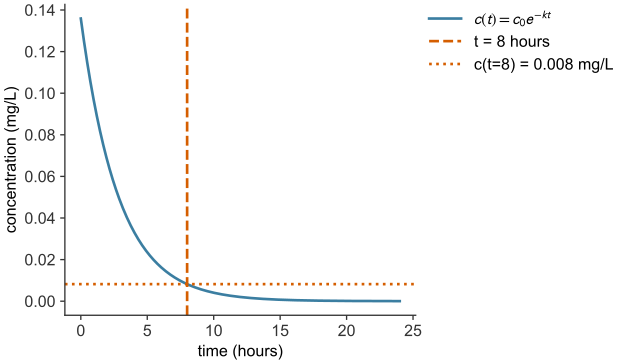
Now, we solve for a \(C_{0}\) that will give us exactly the effective pain-relieving concentration after 8 hours. At this initial dose, the concentration of morphine will just start to become ineffective as the patient wakes up.
Solving for \(c_{0}\) gives a concentration of \(0.1359\ \mathrm{mg/L}\) (keeping the significant figures of the given data).
import matplotlib.pyplot as pltimport numpy as np# Define the function for the concentration over timedef concentration(t, c_0, k):return c_0 * np.exp(-k * t)# Parametersc_0 =0.1359# Initial concentration (mg/L)k =0.351# Elimination rate constant (1/hr)C_at_8 =8.2E-3# Time points from 0 to 24 hourst = np.linspace(0, 24, 500)# Calculate the concentration over timeC_values = concentration(t, c_0, k)marker_color ="#D55E00"# Okabe-Ito vermillion: the queried time/valuefig, ax = plt.subplots()ax.plot(t, C_values, color="#0072B2", lw=1.8, label=r'$c(t) = c_0 e^{-kt}$')ax.axvline(x=8, color=marker_color, linestyle='--', lw=1.2, label='t = 8 hours')ax.axhline(y=C_at_8, color=marker_color, linestyle=':', lw=1.2, label=f'c(t=8) = {C_at_8:.3f} mg/L')ax.set_xlabel('time (hours)')ax.set_ylabel('concentration (mg/L)')ax.legend(loc="upper left", bbox_to_anchor=(1.02, 1.0), borderaxespad=0)fig.tight_layout()plt.show()
Figure 36.2: Single-compartment plasma-concentration decay for the morphine scenario, with the 8-hour dosing interval and the pain-relief threshold concentration marked.
How much should the doctor inject to achieve this initial dose?
How much should she inject? To estimate this, we should remember that the volume of distribution for morphine is approximately 1.0 L/kg. This volume of distribution is a very simple estimation of the volume that the morphine will occupy per mass of the patient.
For a \(V_d\) of 1 L/kg, a 61 kg person, the morphine is distributed in 61 L. Therefore, one must inject: 0.1359 mg/L \(\times\) 61 L = 8.29 mg
Since we’ve made a number of simplifying assumptions in our compartmental model, we interpret this as “somewhere around 8 mg.”
The figures here are simplified but realistic in magnitude. The chosen elimination rate constant \(k = 0.351\ \mathrm{hr}^{-1}\) corresponds to a half-life \(t_{1/2} = \ln 2 / k \approx 2.0\) hr, close to morphine’s measured elimination half-life of a few hours, and morphine’s volume of distribution is of order one liter or more per kilogram (Lugo and Kern 2002).
TipProblem 2
A veterinary team tests a temporary vocalization tracer in dogs. The formulation has density \(9\ \mathrm{g/mL}\), and the effective volume of distribution is \(0.6\ \mathrm{L/kg}\). A 15 kg dog receives 10 mL. After 168 hours, the measured concentration is \(0.002\ \mathrm{g/L}\).
Using the one-compartment model, estimate the elimination rate constant \(k\).
NoteAnswer 2
Parameter
Value
Compound Density
9 g/mL
Compound Intake
10 mL
Volume of distribution (Vd)
0.6 L/kg
Time (t)
168 hours
Find initial concentration of compound intake
At time \(t=0, c(t)\) must be \(c_{0}\) (the initial concentration)
We use the first to solve for A.
\[
c_{0}=A e^{0}
\]
Which gives us \(\mathrm{A}=c_{0}\) and
\[
c(t)=c_{0} e^{-k t}
\]
Now, we solve for a \(C_{0}\) given the parameters.
A second test is done in a 600 kg horse with the same 10 mL dose and the same \(V_d=0.6\ \mathrm{L/kg}\). Assume the elimination rate constant scales with body-surface-area proxy as \(k\propto W^{0.73}\) (the exponent arises because drug clearance scales with metabolic rate, which scales with body surface area \(\propto W^{2/3}\approx W^{0.67}\), giving an empirical exponent close to 0.73). How long until concentration reaches \(0.002\ \mathrm{g/L}\)?
NoteAnswer 3
Scaled elimination rate constant
For a 15 kg dog, the volume of distribution for the compound \(V_{d}\) will be 0.6 L/kg. We often assume that the clearance rate is proportional to the patient’s surface area.
We can estimate the SA from the body weight
\[
\text{Surface area} = 1.73\left(\frac{\text{Body weight in kg}}{70}\right)^{0.73}
\]
If the clearance rate is proportional to the surface area of the patient, then we can estimate k for the horse of 600 kg:
Solving for \(t\) gives an elimination time of \(6.45\,\mathrm{hr}\).
import matplotlib.pyplot as pltimport numpy as npdef concentration(t, c_0, k):return c_0 * np.exp(-k * t)# Parametersc_0 =10# Initial concentration (mol/L)k =5.07E-2# Elimination rate constant (1/hr)C_at_168 =0.002t = np.linspace(0, 1000, 500)C_values = concentration(t, c_0, k)marker_color ="#D55E00"# Okabe-Ito vermillion: the queried time/valuefig, ax = plt.subplots()ax.plot(t, C_values, color="#0072B2", lw=1.8, label=r'$c(t) = c_0 e^{-kt}$')# Highlight 168 hoursax.axvline(x=168, color=marker_color, linestyle='--', lw=1.2, label='t = 168 hours')ax.axhline(y=C_at_168, color=marker_color, linestyle=':', lw=1.2, label=f'c(t=168) = {C_at_168:.3f} g/L')ax.plot(168, C_at_168, 'o', color=marker_color) # marker at the intersectionax.set_xlim(0, 200) # zoom in so the marked time is clearly visibleax.set_xlabel('time (hours)')ax.set_ylabel('concentration (g/L)')ax.legend(loc="upper left", bbox_to_anchor=(1.02, 1.0), borderaxespad=0)fig.tight_layout()plt.show()
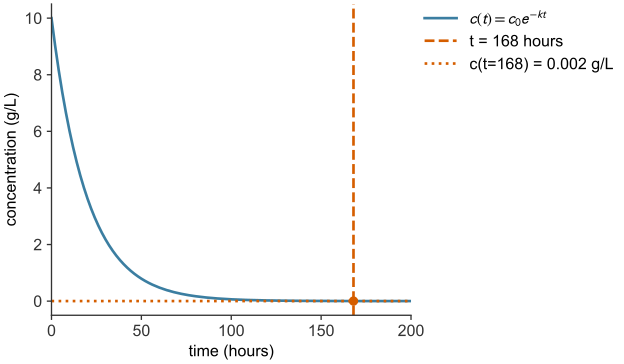
Figure 36.3 plots this decay curve against the measured concentration at t = 168 hours.
Figure 36.3: Single-compartment plasma-concentration decay curve plotted with the dog’s c0 and k from the Answer 3 working, marked at t = 168 hours against the 0.002 g/L measured concentration.
TipProblem 4: Half-life, clearance, and decay time
Return to the morphine model of Problem 1: a first-order elimination rate constant \(k = 0.351\ \mathrm{hr}^{-1}\) and a volume of distribution \(V_d = 61\) L for the 61 kg patient.
Compute the elimination half-life \(t_{1/2}\).
Compute the clearance \(CL = k\,V_d\), and express it in milliliters per minute.
Starting from the initial concentration \(c_0\), how long does it take for the plasma concentration to fall to one-tenth of \(c_0\)?
NoteAnswer 4
Half-life. The half-life follows directly from the rate constant,
Converting, \(21.4\ \mathrm{L/hr} \times \frac{1000\ \mathrm{mL/L}}{60\ \mathrm{min/hr}} \approx 357\ \mathrm{mL/min}\) of plasma is cleared of drug each minute.
Time to one-tenth. Setting \(c(t)/c_0 = e^{-kt} = 0.10\) and solving,
This is comparable to the eight-hour interval of Problem 1: by morning the concentration has fallen to roughly a tenth of its starting value, which is why the initial dose had to be chosen so that even this reduced level stays above the pain threshold.
import numpy as npk =0.351# 1/hr, elimination rate constant (Problem 1)Vd =61.0# L, volume of distributiont_half = np.log(2) / k # elimination half-life (hr)CL = k * Vd # clearance (L/hr)CL_mL_min = CL *1000/60# clearance (mL/min)t_tenth = np.log(10) / k # time to fall to 10% of c0 (hr)print(f"(1) half-life t_1/2 = ln2/k = {t_half:.2f} hr")print(f"(2) clearance CL = k*Vd = {CL:.1f} L/hr = {CL_mL_min:.0f} mL/min")print(f"(3) time to 10% of c0 = ln10/k = {t_tenth:.2f} hr")
(1) half-life   t_1/2 = ln2/k   = 1.97 hr
(2) clearance   CL = k*Vd       = 21.4 L/hr = 357 mL/min
(3) time to 10% of c0 = ln10/k  = 6.56 hr
TipProblem 5
A drug has a minimum effective concentration of \(5~\text{mg/L}\) and a minimum toxic concentration of \(15~\text{mg/L}\).
A patient’s plasma concentration is measured at \(3~\text{mg/L}\); is the drug effective? At \(18~\text{mg/L}\), is it safe?
Starting from the bottom of the window, by what factor could the concentration rise before reaching toxicity?
A second drug has a window from \(8\) to \(9~\text{mg/L}\). Which of the two drugs has the narrower therapeutic index, and what does that imply for its dosing?
NoteAnswer 5
At \(3~\text{mg/L}\) the concentration is below the minimum effective concentration of \(5~\text{mg/L}\), so the drug is ineffective. At \(18~\text{mg/L}\) it exceeds the minimum toxic concentration of \(15~\text{mg/L}\), so it is unsafe (toxic).
From \(5\) up to \(15~\text{mg/L}\) is a factor of \(15/5 = \mathbf{3}\): the concentration could rise threefold before crossing into toxicity.
The second drug’s window (\(8\)–\(9~\text{mg/L}\), a factor of \(9/8 = 1.125\)) is far narrower than the first’s (a factor of \(3\)), so the second drug has the narrower therapeutic index. Its effective and toxic levels nearly coincide, so its dose must be chosen and monitored with much greater precision; a small error in dose or in clearance could push it out of the window in either direction.
TipProblem 6
A \(500~\text{mg}\) dose of a drug is injected intravenously and, once distributed, produces a plasma concentration of \(2.5~\text{mg/L}\). (Take elimination during the brief distribution phase to be negligible, so the full dose is still in the body.)
Compute the volume of distribution.
An adult’s plasma volume is about \(3~\text{L}\) and total body water about \(42~\text{L}\). What does this \(V_d\) indicate about where the drug goes?
A second drug, given at the same \(500~\text{mg}\) dose, shows a plasma concentration of \(0.5~\text{mg/L}\). Is its volume of distribution larger or smaller, and by what factor?
NoteAnswer 6
\(V_d = \dfrac{\text{amount in body}}{\text{plasma concentration}}
= \dfrac{500~\text{mg}}{2.5~\text{mg/L}} = \mathbf{200~\text{L}}\).
\(200~\text{L}\) far exceeds the plasma volume (\(3~\text{L}\)), total body water (\(42~\text{L}\)), and even the physical volume of the body. Such a large \(V_d\) means the drug does not remain in the plasma but binds extensively in the tissues, leaving only a small concentration in the blood to be measured — the “volume” is apparent, not anatomical.
\(V_d = 500/0.5 = 1000~\text{L}\), larger by a factor of \(5\). At a fixed dose, \(V_d\) is inversely proportional to the plasma concentration, so dividing the concentration by \(5\) (from \(2.5\) to \(0.5~\text{mg/L}\)) multiplies the volume of distribution by \(5\): less drug remains in the plasma, so more of it has moved into tissue.
TipProblem 7
A drug is eliminated with first-order kinetics. Its clearance is \(CL = 6~\text{L/h}\), and the target steady-state concentration in the middle of its therapeutic window is \(C_{ss} = 4~\text{mg/L}\).
At what constant rate (in mg/h) must the drug be infused to hold this concentration?
If the volume of distribution is \(30~\text{L}\), what is the elimination rate constant \(k\)?
Explain, from the mass balance, why the required infusion rate does not depend on the volume of distribution.
NoteAnswer 7
At steady state, rate in \(=\) rate out \(= CL \cdot C_{ss}
= 6~\text{L/h} \times 4~\text{mg/L} = \mathbf{24~\text{mg/h}}\).
\(CL = k V_d \Rightarrow k = CL/V_d = 6/30 = \mathbf{0.2~\text{h}^{-1}}\).
At steady state the accumulation term \(dA/dt\) is zero, so the balance is rate in \(=\) rate out \(= CL\cdot C_{ss}\), which contains only the clearance and the target concentration. The volume of distribution governs how fast the concentration approaches steady state, but not the maintenance rate that sustains it: sustaining a concentration requires only replacing what clearance removes, and clearance already accounts for \(V_d\) through \(CL = kV_d\).
TipProblem 8
For first-order elimination the concentration follows \(C(t) = C_0 e^{-kt}\), and the elimination half-life is \(t_{1/2} = \ln 2 / k \approx 0.693/k\). A drug has \(k = 0.35~\text{h}^{-1}\).
Estimate its half-life.
A dose produces an initial concentration \(C_0 = 12~\text{mg/L}\), and the minimum effective concentration is \(1.5~\text{mg/L}\). Using the fact that the concentration halves every half-life, about how long does the dose remain effective?
A drug is generally considered effectively eliminated after \(4\) to \(5\) half-lives. Roughly how long is that here, and how does it compare with the answer to (b)?
The concentration must fall from \(12\) to \(1.5~\text{mg/L}\), a factor of \(12/1.5 = 8 = 2^3\) — three halvings, hence three half-lives, or \(3 \times 2.0 = \mathbf{6~\text{h}}\). (Equivalently, solving \(1.5 = 12\,e^{-0.35 t}\) gives \(t = \ln(8)/0.35 \approx 5.9~\text{h}\).)
Four to five half-lives is about \(4\text{--}5 \times 2.0 = \mathbf{8\text{--}10~\text{h}}\). The dose stays effective for roughly \(6~\text{h}\) but is not essentially gone until \(8\text{--}10~\text{h}\); the gap is the tail of low, sub-therapeutic concentration between the two, which is why re-dosing is timed to the loss of effect rather than to complete elimination.
References
Bisht, Supriya, Vikas Chauhan, and Preeti Patel. 2026. “Clinical Significance of Volume of Distribution in Pharmacotherapy.” In StatPearls. StatPearls Publishing. https://www.ncbi.nlm.nih.gov/books/NBK545280/.
Lugo, Ralph A., and Steven E. Kern. 2002. “Clinical Pharmacokinetics of Morphine.”Journal of Pain & Palliative Care Pharmacotherapy 16 (4): 5–18. https://doi.org/10.1080/J354v16n04_02.